
Imran pushing for use of EVMs in next polls
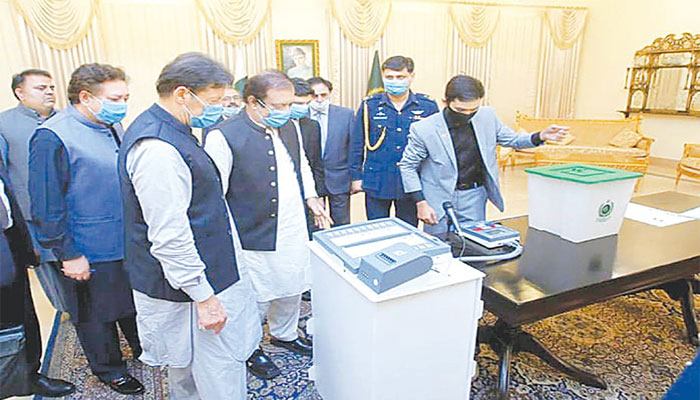
ISLAMABAD: Without any meaningful effort to hammer out an agreement with the opposition, Prime Minister Imran Khan is pushing for the introduction of Electronic Voting Machines (EVMs) in the next general elections.
He has been getting briefings and demonstrations on the operation of the EVMs almost once or twice a week. Now, he has physically cast his vote to judge the performance of the indigenously manufactured apparatus. He is apparently satisfied with its working.
The whole purpose of his recurrent and much publicized emphasis on having EVMs reflects his obsession with electronic voting as some sort of panacea.
He is apparently impressed with the local EVMs but the opposition parties are not impressed.
Extending a helping hand to the prime minister’s campaign for the use of EVMs, President Dr Arif Alvi has also vigorously engaged himself in the process and has regularly called the officials concerned for briefings on the equipment. He is as enthralled with the idea of using EVMs as Imran Khan is. He also does not seem bothered about what the critics’ views are on the proposal.
It is evident that the EVMs can’t be operated in any elections without having a legal cover. An amendment in the Elections Act, 2017 to the effect is a part of a comprehensive package of electoral reforms that was cleared by the National Assembly on June 10. It is awaiting approval by the Senate.
The government has not so far pushed for the smooth sailing of the idea, first in the Senate Standing Committee on Parliamentary Affairs, and then in the Upper House of Parliament. It can be translated into reality only through discussion and debate with the opposition parties, leading to a consensus.
No official initiative is in sight to fruitfully have the opposition, which dominates the Senate, on board to get the EVM amendment approved by the Upper House as well. Some federal cabinet members keep publicly offering talks to the opposition parties to evolve a consensus on the poll reforms, including the use of EVMs. However, their statements serve no purpose except embellishing the news carried by the print and electronic outlets as they are not taken seriously by the other side. It appears as if they are meant for such consumption without any serious attempt to hold a dialogue.
Interestingly, the 20-member National Assembly Standing Committee on Science & Technology, headed by Pakistan Muslim League-Nawaz (PML-N) lawmaker Sajid Mehdi, which meets on August 26, will get a “comprehensive briefing” on the EVMs prepared by COMSATS University Islamabad and the National Institute of Electronics. This is despite the fact that this amendment in the Elections Act had already been okayed by the Lower House of Parliament in indecent haste, without any debate. The same had happened in the National Assembly Standing Committee on Parliamentary Affairs, where even the Election Commission of Pakistan (ECP) officials had not been allowed to present their views on all the amendments.
The proposed amendment makes it mandatory for the ECP to acquire EVMs for the parliamentary polls. It says the ECP shall procure EVMs for casting of voters in general elections. It replaces the existing Section 103 of the Elections Act, which says the ECP may conduct pilot projects for the utilization of EVMs and the biometric verification system in by-elections in addition to the existing manual procedures for voter verification, casting and counting of votes to assess the technical efficacy, secrecy, security and financial feasibility of the EVMs and the biometric verification system and will share the results with the government, which will lay them in parliament.
The prime minister has been exhibiting his keen interest towards EVMs since long in the face of its equally forceful rejection by the opposition. However, his desire has has not been matched by the government’s endeavours to convince those who disapprove of the proposal.
While EVMs have been introduced in many countries, they were first introduced experimentally at a small scale, and after their success, their use was expanded. But in several cases, the equipment has been used and rejected for lack of transparency and secrecy and due to the distrust of the voters about whether their ballots were actually secured by the candidates they supported.







-
 Shamed Andrew Wants ‘grand Coffin’ Despite Tainting Nation
 -
 Keke Palmer Reveals How Motherhood Prepared Her For 'The Burbs' Role
 -
 King Charles Charms Crowds During Lancashire Tour
 -
 ‘Disgraced’ Andrew Still Has Power To Shake King Charles’ Reign: Expert
 -
 Why Prince William Ground Breaking Saudi Tour Is Important
 -
 AOC Blasts Jake Paul Over Bad Bunny Slight: 'He Makes You Look Small'
 -
 At Least 53 Dead After Migrant Boat Capsizes Off Libya
 -
 'God Of War' Announces Casting Major Key Role In Prime Video Show
 -
 Real Reason Prince William, Kate Broke Silence On Andrew Scandal Revealed
 -
 Drew Barrymore Responds To 'Charlie's Angels' Costar's Comments About Her
 -
 Shakira Slips Hard On Stage During Life Show
 -
 King Charles Speaks Out Over Andrew's Scandal: 'Stand Ready To Help Police'
 -
 Dax Shepard Recalls Horrifying Accident That Almost Killed Him
 -
 Logan Paul's Bodyguard Hits Fan On Super Bowl Day
 -
 Epstein Files: Anne Hathaway Mentioned As Highly Desired Guest For Bill Gates?
 -
 Prince Harry Under A Lot Of Stress As Meghan Markle Makes Bizarre Demands