
War of words at first face-to-face US, China meeting
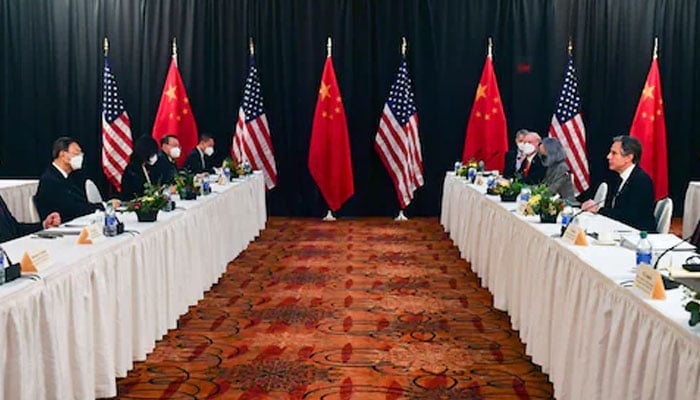
ANCHORAGE: US and Chinese diplomats clashed Thursday in their first face-to-face talks since President Joe Biden took office, with the world’s top two powers each digging in on a laundry list of issues on which they diverge broadly as the meeting opened in Alaska. China’s actions “threaten the rules-based order that maintains global stability,” US Secretary of State Antony Blinken said at the opening of the two-day meeting in Anchorage.
The US side will “discuss our deep concerns with actions by China, including Xinjiang,” where Washington has accused Beijing of “genocide” against Uyghur Muslims, Blinken told the Chinese Communist Party’s top diplomacy official, Yang Jiechi, and Foreign Minister Wang Yi. He added that there would be dialogue on “Hong Kong, Taiwan, cyberattacks on the United States, economic coercion toward our allies.”
Beijing was equally sharp in its response. “China is firmly opposed to US interference in China’s internal affairs. We have expressed our staunch opposition to such interference, and we will take firm actions in response,” Yang warned.
Wang denounced the latest US sanctions against senior Chinese officials over what Washington considers Beijing´s quashing of Hong Kong´s freedoms, announced on the eve of the talks.
“This is not supposed to be the way one should welcome his guests,” Wang said. Tensions between Washington and Beijing remain high after relations were pitched into turmoil during Donald Trump´s presidency, which saw a damaging trade war and spats over everything from defense to tech and rights in Hong Kong.
With its frigid temperatures and remote, Pacific location, Anchorage was considered a more neutral meeting ground than Washington or Beijing for the three-session talks that finish Friday morning.
But expectations are limited on both sides and the tone set by the opening statement confirmed the depth of the divide between the rivals. The last meeting in June did nothing to help thaw frosty relations that resembled a new Cold War by the end of Trump´s time in office.
Biden has maintained a tough line on China, and Blinken has said it represents America´s “biggest geopolitical test of the 21st century.”
Still, the Biden team has said it wants to engage diplomatically on the world stage, in a pivot from Trump´s isolationist and ally-berating stance, particularly on issues such as climate change, the pandemic and the non-proliferation of weapons.
White House National Security Advisor Jake Sullivan said Thursday that the United States didn´t want “conflict,” but “we welcome stiff competition.” Yang called on him to “abandon the Cold War mentality,” saying Beijing wanted “no confrontation, no conflict.”
But visibly stung by the American accusations, he reproached the United States at length, demanding Washington “stop advancing its own democracy in the rest of the world.” Blinken responded: “I have to tell you what I´m hearing is very different from what you described. I´m hearing deep satisfaction that the United States is back, that we´re reengaged with our allies and partners.
“I´m also hearing deep concern about some of the actions your government is taking,” he added. A senior Biden administration official in Anchorage accused the Chinese delegation of “grandstanding,” and said it was “focused on public theatrics and dramatics over substance.”
Bonnie Glaser, director of the China Power Project at the Center for Strategic and International Studies, said the talks would have a limited impact. “They will probe whether there is common ground on some issues and whether there are ways to manage and even narrow their differences,” she told AFP.
“Expectations should remain low. A reset of the relationship is not in the cards.” Thursday’s meeting follows a visit Blinken made to Japan and South Korea, two key US allies in the Asia-Pacific region.
While in Tokyo, Blinken warned China against using “coercion and destabilizing behavior.” Blinken and Defense Secretary Lloyd Austin also attended a key summit between leaders of the so-called Quad alliance, which groups the US, Australia, Japan and India as a check on China´s ambitions.
Blinken and allies have criticized China on a slew of issues, including the erosion of autonomy in Hong Kong, tensions around Taiwan and Tibet, the treatment of the Uighur population in Xinjiang, Beijing´s sweeping maritime claims in the South China Sea, the theft of intellectual property and a lack of transparency over the origins of Covid-19.
Elizabeth Economy, a senior fellow at Stanford University´s Hoover Institution, said that while the Biden administration has moved away from Trump´s inflammatory rhetoric, temperatures remain high.
“Honestly, it is difficult to see China changing course on any issue of significance to the United States. We are in a position where our core values and vision of a future world are fundamentally at odds,” Economy said.







-
 Fresh Details Of King Charles, Queen Camilla's US Visit Emerge Amid Andrew Investigation
 -
 Iran 'set To Buy' Chinese Carrier-killer Missiles As US Forces Gather In Region
 -
 Prince Harry And Meghan Unlikely To Meet Royals In Jordan
 -
 Hero Fiennes Tiffin Shares Life-changing Advice He Received From Henry Cavill
 -
 Savannah Guthrie's Fans Receive Disappointing News
 -
 Prince William Steps Out For First Solo Outing After Andrew's Arrest
 -
 Jake Paul Chooses Silence As Van Damme Once Again Challenges Him To Fight
 -
 Google Disrupts Chinese-linked Hacking Groups Behind Global Cyber Attacks
 -
 Four People Killed In Stabbing Rampage At Washington Home
 -
 Meghan Pushes Prince Harry Into Territory That’s Dangerous To His Brand: ‘She Isn’t Hearing A Word Of It’
 -
 Christina Applegate Reflects On Lasting Impact Of Being Molested In Childhood
 -
 Martin Short Makes Big Decision Following Tragic Death Of Daughter
 -
 Antarctica’s Mysterious ‘gravity Hole’: What’s Behind The Evolution Of Earth’s Deep Interior?
 -
 Hilary Duff Addresses Ashley Tisdale's 'toxic Mom Group' Claims And Matthew Koma's Firey Response
 -
 Jack Hughes's Proximity To Trump Angers Tate McRae Fans
 -
 Neve Campbell Opens Up About Her 'difficult Decision' To Not Sign 'Scream 6'