
Aurat March hopes to unite people for cause of gender, social justice
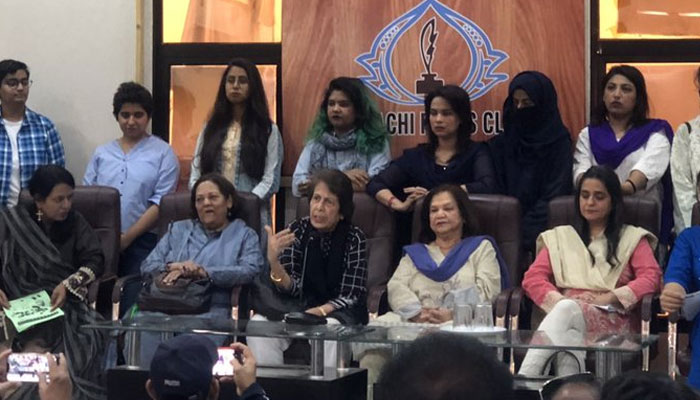
Organisers of the third Aurat March said on Tuesday that the main objective of the rally scheduled for March 8 — International Women’s Day — at the Frere Hall is to unite women and transgender and non-binary people for the cause of gender and social justice through collective action based on the principles of inclusion, dignity, freedom and equality.
They were speaking at a well-attended news conference at the Karachi Press Club. Performer and women’s rights activist Sheema Kermani moderated the discussion while experts from nine sections of society talked about the march, its politics and their eight key demands.
The Sindh Human Rights Commission’s Justice (retd) Majida Rizvi, Sindh Commission on the Status of Women Chairperson Nuzhat Shirin and former National Human Rights Commission member Anis Haroon also attended the conference to support the march.
They said the marchers’ main mission is to seek gender equity — not just for women but also for transgender people and anyone who is a victim of hate crime and discrimination on the basis of their gender or gender identity. They also said that it is the government’s responsibility to provide security to the marchers.
Researcher Nazish Brohi said the women of the country have gained several rights because of a number of women’s movements and the presence of female lawmakers in parliament.
Regarding incidents of women being barred from exercising their right to vote in various parts of the country, she said that at least 10 per cent female voter turnout has become mandatory in every constituency and barring women from voting has become a crime because of the struggle of women groups and parliamentarians.
“In the past women were not even allowed to make their own national identity cards and were using the name of their fathers or husbands in identity documents. The practice was changed due to a campaign by women’s rights group.”
Lawyer Abira Ashfaq said the Aurat March has been highlighting the cause of the rights of every affected segment of society, and those affected by the ongoing eviction drive in the city are part of that.
“The evictions have mainly been affecting women because they are tied to their houses,” she said. Without providing alternative places to the affected people, demolition of houses is unlawful and the marchers will oppose it as well, she added.
Academic Shama Dossa said that a woman dies every 37 minutes in Pakistan from complications during childbirth, indicating poor maternal health care in the country.
She praised the provincial government for making Sindh the first province to pass a reproductive health care rights bill, saying that women and transgender and non-binary people have the right to make an informed decision about pregnancy and childbirth as well as to have access to quality and free health care and reproductive and maternity health services.
Journalist Afshan Sabohi said women have been playing a major role in contributing to the country’s GDP. She said that mostly women have been affected because of the worst economic condition prevailing in the country. “But women know how to survive and run their homes in such a situation.”
Minority rights activists Pastor Ghazala Shafiq and Safina Javed demanded that the Sindh government urgently pass the bill on forced conversions to protect girls and women from them. They also demanded setting up of an autonomous minority rights commission comprising community leaders and representatives to conduct inquiries into forced conversion cases.
Transgender people’s rights activist Shehzadi Rai said the federal and provincial governments should legislate against rape of transgender people. “Because of not having a proper law in the country, transgender people have been facing huge problems in getting FIRs registered in cases of violence.”
She demanded the implementation of the provincial government’s decision of allocating a quota of five per cent in jobs for members of the transgender community. Journalist Uzma Alkarim stressed the need for jointly struggling to initiate concerted efforts to produce media content that is gender-neutral and gender-sensitive.
The participants paid tributes to the late women’s rights and urban rights activists, including Asma Jehangir, Sabeen Mahmud, Perween Rahman, Nigar Ahmed and Fahmida Riaz.







-
 Kanye West's Best Songs: Fans Argue Over Bold Top 10 Ranking On Social Media
 -
 King Charles Secretly Relies On Advice From THIS Royal
 -
 Jennifer Garner Reveals Beauty Choice She Makes As Botox Alternative In Her 50s
 -
 Kate Middleton Drops Four-word Message For Young Girl After Wales Visit
 -
 Shamed Andrew Uncensored ‘massages’ Should Be Refunded To Public
 -
 Kylie Kelce Reveals Rules She Wants Daughter Bennett To Learn At 3: No More 'passies'
 -
 Smartphone Market Set For Biggest-ever Decline In 2026
 -
 Mud, Rain, Loincloths: All About Japan’s 200-year-old Harvest Wrestling Ritual
 -
 Jonathan Majors Set To Make Explosive Comeback To Acting After 2023 Conviction
 -
 Next James Bond: Why Jacob Elordi May Never Get 007 Role?
 -
 Maddox Drops Pitt From Surname In Credits Of Angelina Jolie’s New Film 'Couture' Despite Truce From Father's End In Legal Battle
 -
 Meghan Markle Adds Diamonds To Engagement Ring For Jordan Trip
 -
 Burger King Launches AI Chatbot To Track Employee Politeness
 -
 Andrew’s Woes Amid King Charles’ Cancer Battle Triggers Harry Into Action For ‘stiff Upper Lip’ Type Dad
 -
 Experts Warn Andrew’s Legal Troubles In UK Could Be Far From Over
 -
 Teyana Taylor Reflects On Dreams Turning Into Reality Amid Major Score