
Kashmir has always been an international issue: US HR body
Kashmir has always been an international issue: The Tom Lantos Human Rights Commission, a bi-partisan group of US Congress, has called India to end systematic violations in Indian Occupied Kashmir (IOK).
WASHINGTON: The Tom Lantos Human Rights Commission, a bi-partisan group of US Congress, has called India to end systematic violations in Indian Occupied Kashmir (IOK).
“Clearly, we are at a crisis point right now,” co-chair of the infamous Commission, Congressman James McGovern said talking to The News while discussing human rights situation in Indian occupied Kashmir.
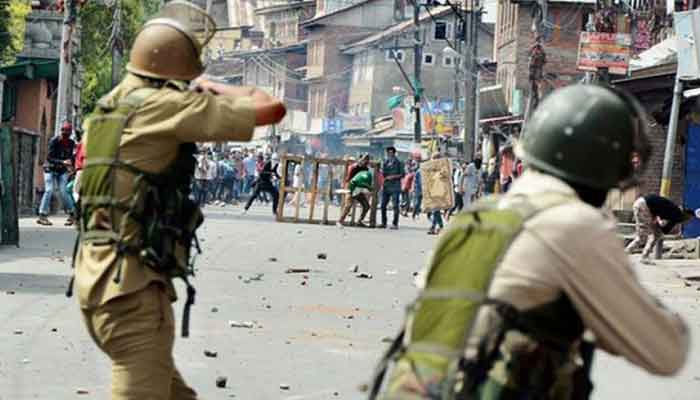
The commission on Thursday had arranged a special hearing to examine the human rights situation in Kashmir. The Indian government’s decision to change the legal status of the Muslim majority state of Jammu and Kashmir, announced in August, has attracted intense attention due persistent reports of human rights violations, including a crackdown on freedom of expression, the arbitrary “preventive” detention of hundreds of politicians, lawyers, journalists, and other civil society figures and related fears of enforced disappearance; the use of excessive force against protesters.
The increased militarisation of the security presence in the region and the economic and social consequences of the central government’s actions, including continuing restrictions on internet and phones, have also provoked widespread concern, the commission said in its announcement.
The commission had a handful of witnesses, half of them Kashmiris themselves, and almost all shared their personal experiences with the commission members highlighting Indian atrocities in Kashmir. The panelists and the commission members were in agreement in demanding the release of detainees, giving foreign journalists and legal observers access to the region, and end blackout.
“We believe that international media ought to be allowed in, members of Congress or other parliamentarians ought to be allowed in, UN ought to be allowed in, international observers ought to be allowed in,” Congressman McGovern said.
Urging India to open up Kashmir and restore normalcy, he called it “an important first step,” and then added “we have engaged the administration and also to be in touch with the Indian government and Pakistani government.”
The room where the hearing took place was jam-packed. During testimonies, attendees were emotional and at times charged, sneaking out booing and then passionate clapping whenever the panelists or Commission members demanded that the Modi government should end human rights violations.
“Kashmir has always been an international issue,” the panelists agreed. Arjun Sethi, Human Rights lawyer and Adjunct Professor at Georgetown Law said at the hearing that Hindu Nationalists mob target Muslims, Dalits and Christians; sometimes forcing them to recite Hindu scriptures. “Hindu nationalism isn’t new to India, but it is on the rise,” he said.
Another witness, Haley Duschinski, Associate Professor of Anthropology and Director of Center for Law, Justice and Culture, Ohio University detailed Indian occupation of the Kashmir region. The second stage of Indian occupation of Kashmir began in the late 1980s as Kashmiris watched a popular armed rebellion against the Indian state, she said adding, Although, the armed rebellion faded by the late 1990s, India’s counter-insurgency regime has remained in place, international human rights bodies have condemned extra judicial killings, illegal detentions, torture, sexual violence, forced disappearances and mass graves across the last three decades.
“Haley told the commission further adding that the third stage of Indian occupation began on Aug 5, 2019. The Indian government's unilateral abrogation of J&K special status is in serious violation of passed UN Security Council resolution regarding the Kashmiri rights of self-determination.”
Haley said that fact-finding reports indicate that number of detainees has been higher than 10,000 and approach some 20 to 30 thousand.
By the end of the more than 3 hours long hearing, the panelists and members of the Congress that attended the hearing, including David Trone, David Cicilline, Sheila jackson Lee, Brian Fitzpatrick, Pramila Jayapal, and Chris Smith, agreed that the UN, foreign journalists and international observers should be allowed into Kashmir and ban on communication should be lifted.






-
 Benny Blanco Addresses ‘dirty Feet’ Backlash After Podcast Moment Sparks Online Frenzy
 -
 Sarah Ferguson Unusual Trait That Confused Royal Expert
 -
 Prince William, Kate Middleton Left Sarah Ferguson Feeling 'worthless'
 -
 Ben Affleck Focused On 'real Prize,' Stability After Jennifer Garner Speaks About Co Parenting Mechanics
 -
 Luke Grimes Reveals Hilarious Reason His Baby Can't Stop Laughing At Him
 -
 Why Kate Middleton, Prince William Opt For ‘show Stopping Style’
 -
 Here's Why Leonardo DiCaprio Will Not Attend This Year's 'Actors Award' Despite Major Nomination
 -
 Ethan Hawke Reflects On Hollywood Success As Fifth Oscar Nomination Arrives
 -
 Tom Cruise Feeling Down In The Dumps Post A Series Of Failed Romances: Report
 -
 'The Pitt' Producer Reveals Why He Was Nervous For The New Ep Of Season Two
 -
 Maggie Gyllenhaal Gets Honest About Being Jealous Of Jake Gyllenhaal
 -
 'Bridgerton' Star Luke Thompson Gets Honest About Season Five
 -
 Prince William On Verge Of Breakdown Because Of 'disgraced' Andrew
 -
 Tig Notaro Reflects On Oscar Nod For 'Come See Me In The Good Light': 'I Was Sleeping'
 -
 Kenyon Sadiq Sets 40-yard Dash Record At NFL Scouting Combine, Eyes First Round
 -
 Talk Show Host Drops Hint About Taylor Swift, Travis Kelce Wedding Date