
Handling the maulana
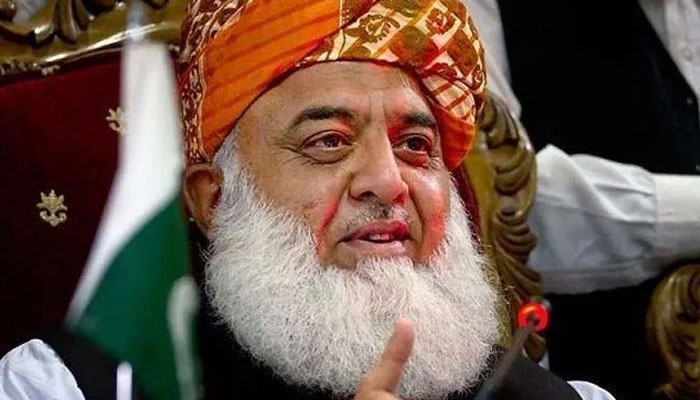
Who would have thought that the PTI's winter of discontent would arrive so soon – and that too at the hands of Maulana Fazlur Rehman, whom the ruling party considered as the 12th man of Pakistani politics.
Ironically, Maulana is giving the PTI a taste of its own medicine by marching onto Islamabad, demanding the resignation of the prime minister and calling for early elections. It is déjà vu all over again: the allegations and demands of Maulana’s 'Azadi March' are no different from the PTI’s 2014 dharna.
Maulana and the government are not ready to budge. In this polarised political atmosphere, the provocative speeches and statements from the government further added to the political volatility in the country. Pakistan’s fragile democracy is the ultimate victim of this politics of vendetta and confrontation.
Despite its restoration in 2008 and three peaceful power transitions, democracy in Pakistan remains procedural where election results are tempered with breeding political disputes. As a result, parliament and rule of law in the country remain weak and non-performative. This state of affairs provides others an outsize role in the political sphere.
Any use of force by the government against the Azadi March participants would be counterproductive. In fact, the government would do Maulana a favour by resorting to baton-charge, teargassing, water-cannoning or large-scale arrests. The last thing the PTI would want is to hand over a Model Town like incident to Maulana. It is the government’s responsibility to find a way out of the current deadlock and handle the situation politically by engaging the protesters instead of resorting to administrative measures.
Through the Azadi March, Maulana has turned a new chapter in his politics. Not only has he come out of the political wilderness, he has also center-staged himself in national politics by exploiting the vacuum created by the arrests of Asif Ali Zardari, Nawaz Sharif, who is now on eight-week bail on health grounds, and Maryam Nawaz (who is also out on bail now). Bilawal Bhutto and Shahbaz Sharif are no match for Maulana’s shrewd politics. On the Azadi March stage in Islamabad’s H-9 sector, both were seen playing second fiddle to Maulana.
At the same time, Maulana has kept his allies and opponents in a constant fix. Both the PPP and the PML-N's position on the Azadi March has been neither here nor there. Though both parties are supporting Maulana’s demand for the PM’s resignation and for early elections, they have stayed away from the sit-in.
Hitherto, the JUI-F has been known as a religious-political party in Pakistan’s political landscape. For the first time, Maulana is doing mainstream politics on national issues instead of solely relying on religious card. In doing so, he has attracted the attention of different segments of Pakistani society outside of his traditional political base. So far, he seems fairly successful in finding pockets of support in Pakistan’s urban landscape, but it remains to be seen if this support will translate into other gains or not. However, Maulana's apparently bold political stance on interference with democratic institutions has astonished even his staunch critics.
In the recent past, those political parties which staged sit-ins in Pakistan have reaped instant political benefits. This fact is not lost on Maulana. For instance, the PAT of Dr Tahirul Qadri, TLP of Maulana Khadim Hussain Rizvi and the PTI have immensely benefited from politics of protests, agitation and confrontation. The ongoing sit-in will particularly benefit the JUI-F in Khyber Pakhtunkhwa where the PTI’s poor governance has created political resentment. Maulana will capitalize on this anti-PTI public sentiment to regain some of the lost political ground in the province.
In the larger picture, however, history suggests that no sit-in has ever succeeded in de-seating a sitting prime minister. Maulana is a seasoned politician and is fully aware of this historical fact. The PTI government has a slight opening in this but it needs to figure out what can do to it handle the situation.
If the deadlock between the government and opposition persists, things could become more complicated. As mentioned above, due to its poor performance, the political narrative is not with the government. The initiative is with Maulana; and the government made a mistake by underestimating Maulana’s political clout and intentions.
In a bizarre reversal of fortunes, the PTI which set the trend of dharna politics is now facing one itself and struggling to tackle it politically. It seems Maulana is finishing what Khan started.
The writer is an associate researchfellow at the S Rajaratnam School of International Studies, Singapore.
Email: isabasit@ntu.edu.sg






-
 Lana Del Rey Announces New Single Co-written With Husband Jeremy Dufrene
 -
 Ukraine-Russia Talks Heat Up As Zelenskyy Warns Of US Pressure Before Elections
 -
 Lil Nas X Spotted Buying Used Refrigerator After Backlash Over Nude Public Meltdown
 -
 Caleb McLaughlin Shares His Resume For This Major Role
 -
 King Charles Carries With ‘dignity’ As Andrew Lets Down
 -
 Brooklyn Beckham Covers Up More Tattoos Linked To His Family Amid Rift
 -
 Shamed Andrew Agreed To ‘go Quietly’ If King Protects Daughters
 -
 Candace Cameron Bure Says She’s Supporting Lori Loughlin After Separation From Mossimo Giannulli
 -
 Princess Beatrice, Eugenie Are ‘not Innocent’ In Epstein Drama
 -
 Reese Witherspoon Goes 'boss' Mode On 'Legally Blonde' Prequel
 -
 Chris Hemsworth And Elsa Pataky Open Up About Raising Their Three Children In Australia
 -
 Record Set Straight On King Charles’ Reason For Financially Supporting Andrew And Not Harry
 -
 Michael Douglas Breaks Silence On Jack Nicholson's Constant Teasing
 -
 How Prince Edward Was ‘bullied’ By Brother Andrew Mountbatten Windsor
 -
 'Kryptonite' Singer Brad Arnold Loses Battle With Cancer
 -
 Gabourey Sidibe Gets Candid About Balancing Motherhood And Career