
Indians have smallest brains in the world
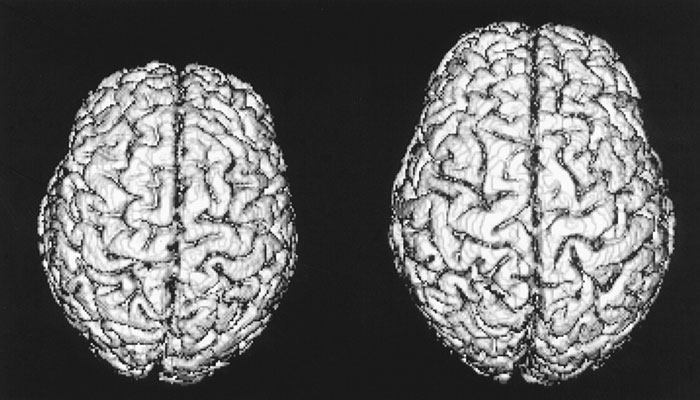
ISLAMABAD: Researchers including those from IIIT Hyderabad developed the first Indian human brain atlas which revealed that India has some of the smallest brains in the world. The study found that there is a significant difference in the shape and size of the brain between Indians, Chinese, Koreans and Caucasians. In fact, the brain size of Indians is smaller in height, width, and volume in comparison with the western and other eastern populations, reported the India Today.
Who all were involved in the research? The study, published in the journal Neuroscience India, was a collaborative effort by researchers Raghav Mehta from McGill University in Canada, Jayanthi Sivaswamy and Alphin J Thottupattu from the International Institute of Information Technology (IIIT), Hyderabad, and R Sheelakumari and Chandrasekharan Kesavadas from Sree Chitra Tirunal Institute for Medical Sciences and Technology in Kerala.
According to the study, a brain atlas helps researchers compare findings from different brain imaging methods like Magnetic Resonance Imaging (MRI) and functional MRI (fMRI), or between healthy and diseased brain states, or across individuals.
The Montreal Neurological Institute (MNI) in Canada, and the International Consortium for Brain Mapping (ICBM) created the world's first digital human brain atlas using the brain MRI scans of 305 young normal Caucasian subjects. However, the researchers said that the brain atlas does not account for differences across groups with different gender, race, or disease conditions. The researchers recruited 100 young healthy Indian adults -- 50 female and 50 male -- aged 2130 years, and developed the Indian atlas from their brain scans.
The result of this study indicated that there is a significant difference in the size of Indian and Caucasian brains in terms of length, width, and height.
Comparison of the Indian, Chinese and Korean brain atlases revealed that the Indian brain is comparable in terms of length with both the atlases, while it was significantly smaller in terms of height and width.
The study, however, did not reveal what functional dissimilarities may exist in these populations due to the brain size deviations.







-
 Ghost's Tobias Forge Makes Big Announcement After Concluding 'Skeletour World' Tour
 -
 Katherine Short Became Vocal ‘mental Illness’ Advocate Years Before Death
 -
 SK Hynix Unveils $15 Billion Semiconductor Facility Investment Plan In South Korea
 -
 Buckingham Palace Shares Major Update After Meghan Markle, Harry Arrived In Jordan
 -
 Demi Lovato Claims Fans Make Mental Health Struggle Easier
 -
 King Hospitalized In Spain, Royal Family Confirms
 -
 Japan Launches AI Robot Monk To Offer Spiritual Guidance
 -
 Japan Plans Missile Deployment Near Taiwan By 2031 Amid Growing Regional Tensions
 -
 Meghan Markle, Prince Harry Spark Reactions With Latest Announcement
 -
 Kate Hudson Reflects On Handling Award Season With No Expectations
 -
 6 Celebrities Who Have Been Vocal About Anxiety And 'panic Attacks'
 -
 Is This The Future Of Train Travel? Robot Dogs, Drones Are Redefining Public Transit Safety Through China’s New Metro Station Deployment
 -
 Sarah Ferguson Seeks Hollywood Backing As Epstein Files Resurface
 -
 China’s AI Milestone: ByteDance’s Doubao Chatbot Hits 100M Users During Lunar New Year
 -
 Think You Know ChatGPT? Here Are 5 AI Levels You’ve Never Seen
 -
 Bitcoin Bounces From $62,000 As On-chain Metrics Signal Prolonged Weakness: Here Is Everything To Know