
Nawaz, Maryam, Safdar’s conviction: LHC bench dissolved
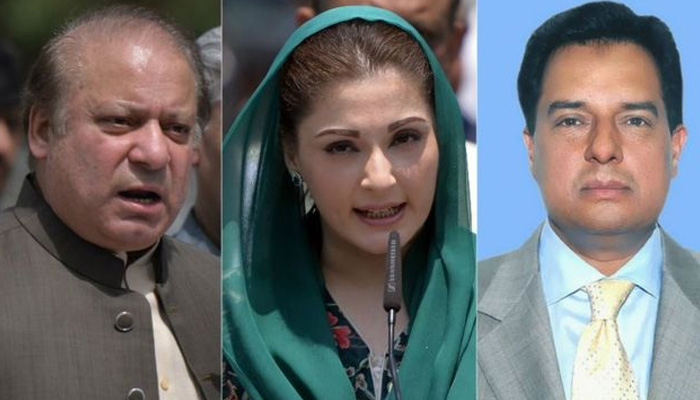
LAHORE: A Lahore High Court full bench constituted to determine the subsistence of the National Accountability Ordinance (NAO) 1999 under which former prime minister Nawaz Sharif, his daughter and son-in-law were convicted, was dissolved on its first hearing on Wednesday.
A three-member full bench, headed by Justice Shams Mahmood Mirza and comprising Justice Sajid Mahmood Sethi and Justice Mujahid Mustaqeem Ahmad, was set to take up the petition. However, Justice Mirza, the head of the bench, declined to hear the petition and recused himself from the case, citing personal reasons.
Resultantly, the bench was dissolved. Justice Mirza sent the petition back to the chief justice for the formation of a new bench. Senior lawyer AK Dogar had filed the petition assailing the conviction of the Sharifs besides challenging the existence of the NAO. The lawyer pleaded that former premier Nawaz Sharif and others had been convicted by a court which hadno jurisdiction because the law under which it (court) had been created was a dead law.
He said the high court should suspend the operation of the accountability court’s judgment for being a court established under a non-existent law.
Challenging the validity of the NAB ordinance, Dogar argued that the ordinance had been promulgated by military dictator Gen (retd) Pervez Musharraf under the Provisional Constitutional Order (PCO) No 1 of 1999 as well as Order No 9 of 1999.
He said the order No 9 was promulgated only to amend PCO No 1 of 1999 by inserting Section 5A (1) into it to the effect that limitation of 120 days prescribed under Article 89 of the Constitution to any ordinance by the president would not be applicable to the laws made under PCO No 1 of 1999.
However, he said that under Article 270-AA of the Constitution through the 18th amendment, the PCO No 1 of 1999 was declared without lawful authority and of no legal effect. He argued that once the PCO No 1 was declared without lawful authority and of no legal effect, the amendments to it made under order No 9 of 1999 would also stand lapsed and, therefore, the limitation period of 120 days prescribed under Article 89 would be applicable to the NAB ordinance.
Dogar asked the court to declare that after the 18th amendment and insertion of Article 270-AA into the Constitution, the NAB ordinance had ceased to be the law and become non-existent and a dead letter.







-
 Trump Revokes Legal Basis For US Climate Regulation, Curb Vehicle Emission Standards
 -
 DOJ Blocks Trump Administration From Cutting $600M In Public Health Funds
 -
 2026 Winter Olympics Men Figure Skating: Malinin Eyes Quadruple Axel, After Banned Backflip
 -
 Scientists Find Strange Solar System That Breaks Planet Formation Rules
 -
 Meghan Markle Rallies Behind Brooklyn Beckham Amid Explosive Family Drama
 -
 Backstreet Boys Voice Desire To Headline 2027's Super Bowl Halftime Show
 -
 OpenAI Accuses China’s DeepSeek Of Replicating US Models To Train Its AI
 -
 Woman Calls Press ‘vultures’ Outside Nancy Guthrie’s Home After Tense Standoff
 -
 Allison Holker Gets Engaged To Adam Edmunds After Two Years Of Dating
 -
 Prince William Prioritises Monarchy’s Future Over Family Ties In Andrew Crisis
 -
 Timothée Chalamet Turns Head On The 'show With Good Lighting'
 -
 Bucks Vs Thunder: Nikola Topic Makes NBA Debut As Milwaukee Wins Big
 -
 King Charles Breaks 'never Complain, Never Explain' Rule Over Andrew's £12 Million Problem
 -
 Casey Wasserman To Remain LA Olympics Chair Despite Ghislaine Maxwell Ties
 -
 Shaun White Is Back At The Olympics But Not Competing: Here’s Why
 -
 Breezy Johnson Engaged At Olympics After Emotional Finish Line Proposal