
Nawaz, Maryam, Safdar’s conviction: LHC bench dissolved
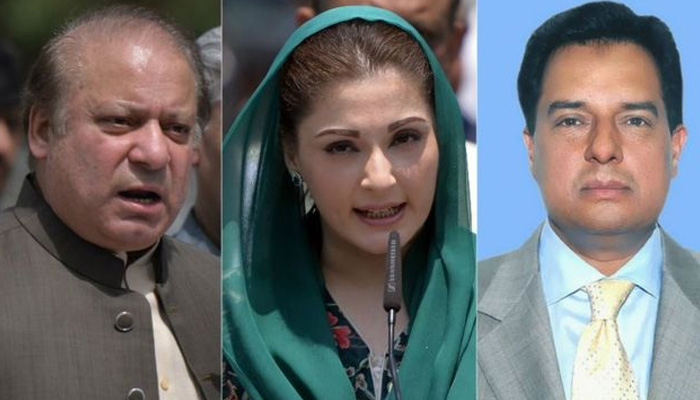
LAHORE: A Lahore High Court full bench constituted to determine the subsistence of the National Accountability Ordinance (NAO) 1999 under which former prime minister Nawaz Sharif, his daughter and son-in-law were convicted, was dissolved on its first hearing on Wednesday.
A three-member full bench, headed by Justice Shams Mahmood Mirza and comprising Justice Sajid Mahmood Sethi and Justice Mujahid Mustaqeem Ahmad, was set to take up the petition. However, Justice Mirza, the head of the bench, declined to hear the petition and recused himself from the case, citing personal reasons.
Resultantly, the bench was dissolved. Justice Mirza sent the petition back to the chief justice for the formation of a new bench. Senior lawyer AK Dogar had filed the petition assailing the conviction of the Sharifs besides challenging the existence of the NAO. The lawyer pleaded that former premier Nawaz Sharif and others had been convicted by a court which hadno jurisdiction because the law under which it (court) had been created was a dead law.
He said the high court should suspend the operation of the accountability court’s judgment for being a court established under a non-existent law.
Challenging the validity of the NAB ordinance, Dogar argued that the ordinance had been promulgated by military dictator Gen (retd) Pervez Musharraf under the Provisional Constitutional Order (PCO) No 1 of 1999 as well as Order No 9 of 1999.
He said the order No 9 was promulgated only to amend PCO No 1 of 1999 by inserting Section 5A (1) into it to the effect that limitation of 120 days prescribed under Article 89 of the Constitution to any ordinance by the president would not be applicable to the laws made under PCO No 1 of 1999.
However, he said that under Article 270-AA of the Constitution through the 18th amendment, the PCO No 1 of 1999 was declared without lawful authority and of no legal effect. He argued that once the PCO No 1 was declared without lawful authority and of no legal effect, the amendments to it made under order No 9 of 1999 would also stand lapsed and, therefore, the limitation period of 120 days prescribed under Article 89 would be applicable to the NAB ordinance.
Dogar asked the court to declare that after the 18th amendment and insertion of Article 270-AA into the Constitution, the NAB ordinance had ceased to be the law and become non-existent and a dead letter.







-
 Bridgerton’s Michelle Mao On Facing Backlash As Season Four Antagonist
 -
 King Charles Gets New ‘secret Weapon’ After Andrew Messes Up
 -
 Shia LaBeouf Makes Bold Claim About Homosexuals In First Interview After Mardi Gras Arrest
 -
 Princess Beatrice, Eugenie ‘strained’ As They Are ‘not Turning Back’ On Andrew
 -
 Benny Blanco Addresses ‘dirty Feet’ Backlash After Podcast Moment Sparks Online Frenzy
 -
 Sarah Ferguson Unusual Trait That Confused Royal Expert
 -
 Prince William, Kate Middleton Left Sarah Ferguson Feeling 'worthless'
 -
 Ben Affleck Focused On 'real Prize,' Stability After Jennifer Garner Speaks About Co Parenting Mechanics
 -
 Luke Grimes Reveals Hilarious Reason His Baby Can't Stop Laughing At Him
 -
 Why Kate Middleton, Prince William Opt For ‘show Stopping Style’
 -
 Here's Why Leonardo DiCaprio Will Not Attend This Year's 'Actors Award' Despite Major Nomination
 -
 Ethan Hawke Reflects On Hollywood Success As Fifth Oscar Nomination Arrives
 -
 Tom Cruise Feeling Down In The Dumps Post A Series Of Failed Romances: Report
 -
 'The Pitt' Producer Reveals Why He Was Nervous For The New Ep Of Season Two
 -
 Maggie Gyllenhaal Gets Honest About Being Jealous Of Jake Gyllenhaal
 -
 'Bridgerton' Star Luke Thompson Gets Honest About Season Five