
Did PTI, MQM agree to abolish job quota regime in MoU?
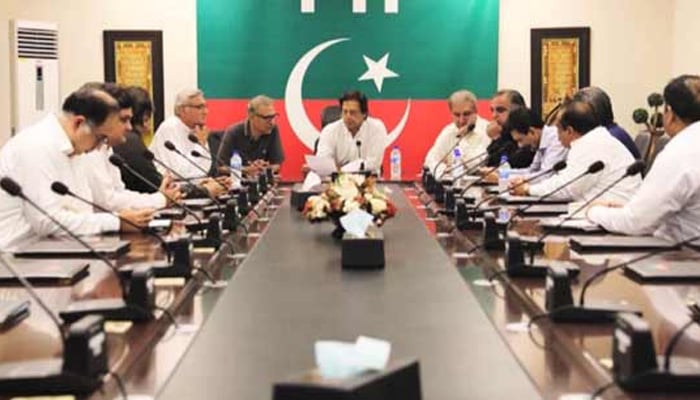
ISLAMABAD: A strategic point of the Memorandum of Understanding (MoU) signed by the Pakistan Tehreek-e-Insaf (PTI) and Muttahida Qaumi Movement (MQM) for cooperation to elect Imran Khan as the prime minister has a big catch. Its point four says all appointments in the government should be based on merit and according to law through an accredited, impartial testing system.
The 1973 Constitution introduced the quota regime in order to give representation to the underdeveloped and backward areas in the federal jobs till the time they come out of this state of affairs.
The catch in the MoU is in the words “according to law”. Will the PTI government keep the present job quota system in place? Or have the two sides agreed to not extend the arrangement beyond 2013? Does the point mean that any kind of accord has been reached between them?
The MQM always wanted to scrap the job quota and has been resisting its extension. The Pakistan Muslim League-Nawaz (PML-N) government had extended it in 1999. The extension lapsed in 2013.
“If the MoU means annulment of quota, it is a big political scoop of the MQM,” a seasoned knowledgeable bureaucrat remarked to The News. He stated that all jobs in the government on merit and according to law implies there was an agreement to do away with the quota. Additionally, merit based jobs may mean an accord to not extend the constitutional provision relating to quota.
However, the MoU said noting specific about the quota. By not using the word “quota” in the agreement, the MoU kept the regime vague and camouflaged the actual issue. The whole matter has been messed up big time because small provinces specifically the regions affected by the non-extension of the quota system will be up in arms.
The cancellation of quota will have serious consequences for rural Sindh, Khyber Pakhtunkhwa (KP), Balochistan and tribal areas. It would mean all jobs of the Central Superior Service (CSS) and other federal quotas would be illegal.
The MQM had not allowed the Pakistan People’s Party (PPP) government to extend the quota. Later, the PML-N also regime could not address the mater since it did not have the two-thirds majority Parliament and the MQM also opposed the extension.
In October, 2017, the federal cabinet instead of approving extension of quota, decided to “revise” it as the underdeveloped and backward areas including Balochistan and tribal areas could not be brought on a par with the developed regions by only granting jobs.
According to the quota system, Punjab including the federal area of Islamabad gets 50pc jobs; and Sindh including Karachi 19pc. The share of Sindh is further sub-allocated with the urban areas, namely Karachi, Hyderabad and Sukkur, getting 40pc of 19pc or 7.6pc; rural areas i.e. rest of Sindh excluding Karachi, Hyderabad and Sukkur 60pc of 19pc or 11.4pc.
The KP gets 11.5pc; Balochistan 6pc; Gilgit–Baltistan and tribal areas 4pc; and Azad Kashmir 2pc. Women have the reserved quota of 10pc, observed and calculated from the share of each province and region.
The MQM believes constitutional quota is violation of merit, and wants federal jobs in Karachi in organisations like PIA, Karachi Port Trust, Port Qasim, State Bank of Pakistan, Pakistan Steel Mills, National Bank of Pakistan and all big federal institutions.
It also wants only residents of Karachi to be accommodated and doesn’t like people from interior Sindh and other provinces taking a share under the quota system.
The quota regime had been governed by Article 27 of the Constitution. It says no citizen otherwise qualified for appointment in the service of Pakistan shall be discriminated against in respect of any such appointment on the ground only of race, religion, caste, sex, residence or place of birth. However, for a period not exceeding forty [inserted in 1999 extending the quota] years from the commencing day [of the Constitution], posts may be reserved for persons belonging to any class or area to secure their adequate representation in the service of Pakistan. In the interest of this service, specified posts or services may be reserved for members of either sex if such posts or services entail the performance of duties and functions which cannot be adequately performed by members of the other sex. Under-representation of any class or area in the service of Pakistan may be redressed in such manner as may be determined by an Act of Parliament.
Nothing shall prevent any provincial government, or any local or other authority in a province, from prescribing, in relation to any post or class of service under that government or authority, conditions as to residence in the province, for a period not exceeding three years, prior to appointment under that government or authority.







-
 Jessie Buckley Reveals Why BAFTA Win Felt Extra 'special' With Cillian Murphy
 -
 Halle Berry Reveals Bedroom Performances That Are Off-limits In Her Engagement To Van Hunt
 -
 Why Nicole Kidman 'not Rushing' Into Love After Split From Keith Urban?
 -
 Benny Blanco's Dirty Feet In Debut Podcast Divide The Internet
 -
 Jeffrey Epstein Blamed King Charles As Andrew Left Trade Enjoy Job
 -
 King Charles Asked To Lean On Princess Anne To Avoid ‘media Circus’
 -
 Passenger Wins £10,000 Payout From Heathrow Airport After 100 Ml Liquids Dispute
 -
 Eric Dane's Costar Under Fire For Hurling Accusations At Him After His Death
 -
 Paul Anthony Kelly Breaks Silence Over Online Discussion About His Chest Hair: 'I Own It'
 -
 Queen Camilla Greets The Paddington Bear At BBC’s 500 Words Grand Final
 -
 Chinese Astronauts Finally Reveal Why Spacecraft Left Them ‘stranded’ For 437 Days In Space
 -
 Khloe Kardashian Reacts To AI Videos With Dad Robert Kardashian Kissing Her: 'That Freaks Me Out'
 -
 Sinitta Makes Shock Admission About Marriage To Andy Willner Post Simon Cowell Heartbreak
 -
 Bill Gates Calls Ties To Jeffrey Epstein 'huge Mistake,' Reveals Past 'affairs'
 -
 Switzerland Announces One-time Compensation For Swiss Bar Fire Victims
 -
 Ryan Coogler Shares Thoughts About Building Community Of Actors Amid 'Sinners' Success