
New provinces, devolution of powers take centre stage in MQM-P manifesto
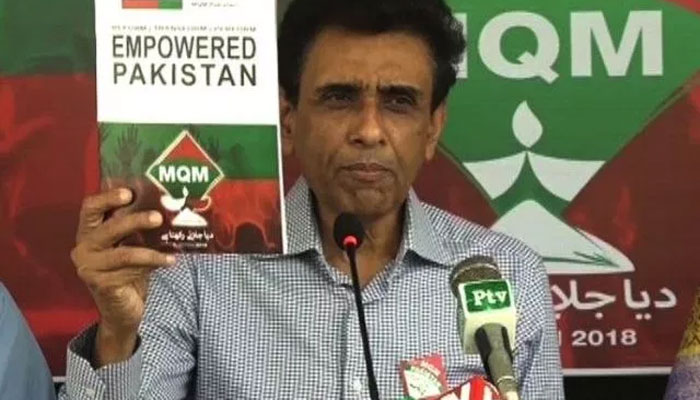
With less than a fortnight until the general elections, the Muttahida Qaumi Movement-Pakistan (MQM-P) released its manifesto on Saturday, with creation of new provinces and devolution of powers to local bodies among the party’s top objectives.
Addressing a news conference at the MQM-P headquarters, party convener Khalid Maqbool Siddiqui presented the 20-point manifesto titled ‘Empowered Pakistan’. He said that on the eve of independence, Pakistan had inherited five provinces and India eight.
Now India has increased its eight provinces to 29 states and seven administrative union territories, he said, adding that Pakistan has a population of 220 million but only four provinces.
Therefore, said Siddiqui, the MQM-P proposes creation of more provinces for better administration. However, he added, these additional provinces will be located within the boundaries of the existing provinces to retain their cultures and historical identities.
Talking about local bodies, he cited the Constitution’s Article 140-A, which clearly states that each provincial government shall establish a local government system and devolve political, administrative and financial responsibilities and authorities to the elected representatives of the local governments.
He said the MQM-P believes in empowerment of the elected representatives of the local government, adding that a schedule of ‘power of the local government’ will be included in the Constitution through an amendment to protect them from the arbitrary attitude of the provincial government.
Siddiqui said local taxes will be transferred to the local government, and the status of Karachi will be restored as a fully autonomous metropolitan corporation on the pattern of mega cities across the world.
The MQM-P manifesto states that law and order will be maintained through recruitment, training and posting of police officers on merit, without any interference by the ruling government.
It also states that an intelligence wing manned by highly proficient officers will be set up in each province to assist the police in keeping them fully informed of the events that can threaten peace.
The party plans to revive the posts of executive magistrates and introduce community policing on provincial or union council level, because “dual control by police and Rangers weakens the policing system”.
“In the early years, before the formation of the province of West Pakistan, Sindh Police Rangers used to serve under the provincial government. Hence, it is proposed to create local Rangers to serve under the provincial governments.”
Siddiqui said the MQM-P will reserve 30 per cent of the total seats, including 10 per cent for women and five per cent for non-Muslims, in national and provincial assemblies for the educated youth in the 25-40 age group. He said his party is a signatory to ‘Ailan-e-Amal’, a minimum education reform agenda to empower Pakistan, adding that the quota system in Sindh has created a gulf between rural and urban populations, and short-sighted rulers have widened this gulf.
Although the quota system ended in 2013, the Sindh government kept using it unconstitutionally, he said, adding that his party demands a permanent end to the discriminatory system and a third-party audit of all the years when the lawful right of the urban Sindh was exploited and even the allocated 40 per cent share was not provided to the urban populace.
Siddiqui claimed that the MQM-P will bring reform to the education system following the Turkish government’s policy for education, under which conventional courses are taught to students in their mother tongue before passing their matriculation exam. He said that for Pakistan to grow, we need to revolutionise our education system.
Regarding the matter of health, the party believes that access to quality health care is the right of every Pakistani, and stresses upon primary and preventative health care instead of tertiary health care.
The MQM-P’s manifesto for the 2018 general elections also highlights the issues of economy, census, terrorism, forced disappearances, poverty alleviation, unemployment, industries, labours sectors, energy, foreign affairs, agriculture, irrigation, judicial system, media, freedom of expression, information technology, overseas Pakistani, women, non-Muslims, environment, youth, sports and social welfare.






-
 Hilary Duff’s Son Roasts Her Outfit In New Album Interview
 -
 Alexandra Daddario, Andrew Form Part Ways After 3 Years Of Marriage
 -
 Eric Dane Rejected Sex Symbol Label
 -
 Avan Jogia Says Life With Fiancee Halsey Feels Like 'coming Home'
 -
 Kate Middleton's Role In Handling Prince William And Harry Feud Revealed
 -
 Tucker Carlson Says Passport Seized, Staff Member Questioned At Israel Airport
 -
 David, Victoria Beckham Gushes Over 'fiercely Loyal' Son Cruz On Special Day
 -
 Taylor Swift Made Sure Jodie Turner-Smith's Little Girl Had A Special Day On 'Opalite' Music Video Set
 -
 Eric Dane Says Touching Goodbye To Daughters Billie And Georgia In New Netflix Documentary
 -
 Channing Tatum Reveals What He Told Daughter After Violent Incident At School
 -
 King Charles Lands In The Line Of Fire Because Of Andrew Mountbatten-Windsor
 -
 Denise Richards Doubles Down On Abuse Claims Against Ex Husband Aaron Phypers Amid Show Return
 -
 Russia Set To Block Overseas Crypto Exchanges In Sweeping Crackdown
 -
 Gwyneth Paltrow Reveals Deep Personal Connection With Kate Hudson
 -
 Prince Harry, Meghan Markle’s Game Plan For Beatrice, Eugenie: ‘Extra Popcorn For This Disaster’
 -
 OpenAI To Rollout AI Powered Smart Speakers By 2027