
Heavy hailstorm batters Islamabad, KP regions
Downpour also triggered flash flooding in some low-lying parts of capital
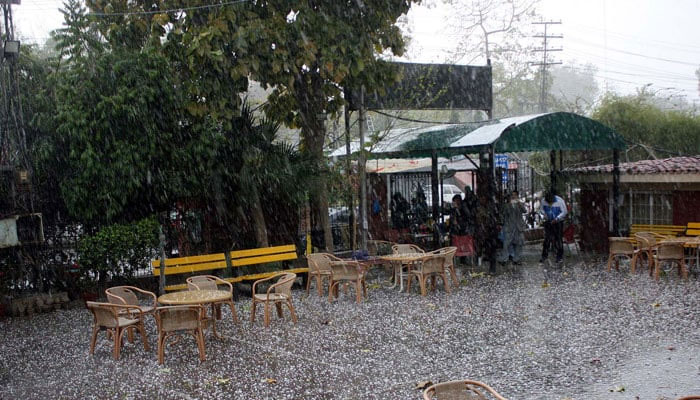
ISLAMABAD/ PESHAWAR: The federal capital and parts of Khyber Pakhtunkhwa (KP) were pummelled by a heavy hailstorm on Wednesday afternoon, leaving a trail of destruction that included smashed car windscreens, damaged solar panels and broken tree branches, reported Geo News.
Several politicians took to X to share their storm experiences, describing the wild weather as both intense and oddly refreshing — a dramatic spell that brought a welcome break from the heat, reported Ge News.
Heavy rain and hail disrupted Islamabad Electric Supply Company’s (Iesco) power distribution system, with several areas experiencing outages due to fallen electricity poles and broken wires, said a power utility spokesperson.
Power supply was suspended across many 11kv feeders due to safety faults and tripping. Affected areas included Golra, PHA, Pir Mehr Ali Shah, F-10 Markaz, National Police Foundation, Service Road East, Carriage Factory, Patriata, Upper Topa, Pir Sohawa, Madina Colony, and Airport Society.
The spokesperson said Iesco’s operations and construction teams restored power in most areas quickly. “Iesco Chief Engineer Muhammad Naeem Jan is directly supervising the restoration work,” the spokesperson added.
In Islamabad, the storm hit suddenly and lasted around 35 minutes, with strong winds and large hailstones battering everything in their path. Tarnol was among the worst-affected areas, where several trees were uprooted, causing traffic disruptions.
The downpour also triggered flash flooding in some low-lying parts of the capital, straining the already overwhelmed drainage systems and catching commuters off guard.
Meanwhile, a hailstorm coupled with heavy rain on Wednesday triggered flash floods in a number of districts in Khyber Pakhtunkhwa, damaging properties and standing crops.
It was learnt that people in Landikotal, Loy Shalman and Bazaar Zakhakhel suffered losses. A number of vehicles, standing crops and houses were damaged in Landikotal.
Road remained closed due to flash floods at 12 points on Afghan Highway for several hours, hindering transit between Torkham and Ali Masjid locality.
At the Torkham border, immigration operations were delayed while cross-border trade was also disrupted.
BATTAGRAM: Torrential rainfall also caused widespread disruption in Battagram, particularly in the main bazaar, where heavy water flow led to a complete blockage of the Karakoram Highway (KKH).
ALPURI: Heavy rainfall accompanied by intense hailstorms wreaked havoc across Shangla district and its surrounding areas, damaging standing crops, orchards, and fruit-bearing trees. The severe weather shattered the windshields of several vehicles in different localities. Upper mountainous areas experienced especially intense hailstorms following torrential rain, while low-lying regions such as Bisham, Maira, Shang, Dandai, and adjoining localities witnessed heavy downpours. The rain also led to a surge in water flow in local streams, seasonal nullahs and rivers. Meanwhile, the National Disaster Management Authority (NDMA) has forecast extreme summer conditions, warning of intensifying heatwaves that could heighten the risk of wildfires in mountainous regions of Khyber Pakhtunkhwa, Balochistan, the Potohar region, Murree, and nearby areas. The three-month forecast (April–June), presented to reporters at the NEOC, indicates that cyclones are expected to form in the Arabian Sea during May and June, with potential impacts on nearby coastal areas. The report indicates that the summer season will bring higher-than-normal temperatures nationwide and below-average rainfall. This extreme heat is anticipated to cause heatwaves, especially in southern Punjab, Sindh, and Balochistan. Temperatures in southern Punjab, Sindh, and Balochistan could climb as high as 45 degrees Celsius, particularly impacting cities such as Karachi, Badin, Larkana, Umerkot, Tharparkar, and Matiari.
Searing temperatures are expected to scorch Sukkur, Shikarpur, Dadu, Sanghar, Bahawalpur, Rahim Yar Khan, and Lahore, whereas Gilgit-Baltistan and Chitral face a dual challenge—extreme heat coupled with the looming threat of GLOFs triggered by rapid glacial melting. The combination of higher temperatures and diminished rainfall is projected to reduce agricultural output nationwide, potentially causing lower crop yields, water scarcity and food security challenges.







-
 Teyana Taylor Reveals What Lured Her Back To Music After Earning Fame In Acting Industry
 -
 Prince William Shows He's Ready To Lead The Monarchy Amid Andrew Scandal
 -
 Lux Pascal Gushes Over Role In Tom Ford's 'Cry To Heaven': 'I Just Wanted To Be Part Of This Picture'
 -
 Near-blind Refugee Found Dead In Buffalo After Release By US Border Patrol
 -
 Firm Steps In Forcing Andrew’s Hand: ‘Can No Longer Keep A Promise'
 -
 Kenyan Man Accused Of Recruiting Men To Fight In Ukraine
 -
 'The Wrong Paris' Star Veronica Long Shares What New Crime Series 'Blue Skies' Is About
 -
 King Charles Remains Immersed In Work Amid Andrew Scrutiny
 -
 Bobby J. Brown's Passing Adds To Growing List Of Celebrity Deaths In 2026
 -
 Prince William Fears For Andrew's Mental Health
 -
 Paige DeSorbo Breaks Silence On New Relationship With Joe D'Amelio
 -
 'Marshals' Showrunner Reveals If Kayce And Beth Will Cross Paths In 'Yellowstone' Spinoff
 -
 Belgium Watchdog Launches Antitrust Probe Into Google Ads Business
 -
 Andrew Ready To Fight Back: 'He's Very Vengeful'
 -
 After Surpassing 100 Million YouTube Subscribers, BLACKPINK Returns With New Release
 -
 Rihanna Sends Fans Into Frenzy With BTS Footage Of Music Making: Watch