
Military trials case: Everyone, including Kulbhushan, has right to counsel, says SC judge
In Shah Zaman case, Haris submitted that accused had stated that grounds were available
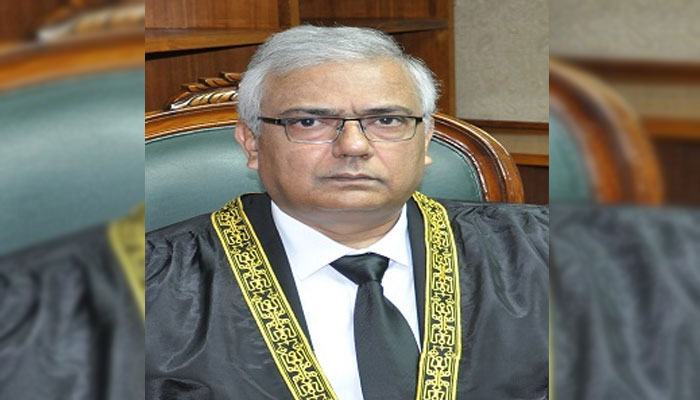
ISLAMABAD: The Supreme Court on Wednesday adjourned the hearing of military courts trial case until Thursday (today) as counsel for the Ministry of Defence continued his arguments in rebuttal.
A seven-member constitutional bench of the apex court, headed by Justice Aminuddin Khan, heard the intra-court appeals filed by the federal government and Ministry of Defence against its judgment declaring the trial of civilians in military courts as unconstitutional.
Khwaja Haris, counsel for the Ministry of Defence, continued his arguments in rebuttal and told the court that he will inform the court whether military trial rules were followed or not.
In the Shah Zaman case, Haris submitted that the accused had stated that grounds were available, but the ground for choosing their lawyer was not available. He said Article 36 relates to foreign nationals, granting them access to a counsellor. He submitted that if someone commits a crime, the country from which they came was referred to as the “sending state”.
Justice Mazhar then remarked that in the case of Kulbhushan would India be called the sending state. Additional attorney general argued that in the context of the sending state, the individual would be considered a citizen of that state.
Justice Mazhar responded: “Whether India acknowledges it or not, we will say they sent him…according to the Vienna Convention, in Kulbhushan’s case, India is indeed the sending state.”
Khawaja Haris argued it was said that the Indian spy was granted the right to appeal, our own citizens were not given the same.
He submitted that Kulbhushan was granted counsellor access under the Vienna Convention, but this should not be equated with the right to appeal.
Justice Mazhar remarked that whether it was Kulbhushan or any other foreign national, counsellor access was the right for all.
Justice Rizvi asked Haris if an accused cannot afford a lawyer, will the government provide one. Khawaja Haris responded in affirmative saying that in such cases, the government provides a public lawyer. Later, the court adjourned the hearing until Thursday (today) wherein Khwaja Haris will continue his arguments in rebuttal.







-
 Prince Harry And Meghan Unlikely To Meet Royals In Jordan
 -
 Hero Fiennes Tiffin Shares Life-changing Advice He Received From Henry Cavill
 -
 Savannah Guthrie's Fans Receive Disappointing News
 -
 Prince William Steps Out For First Solo Outing After Andrew's Arrest
 -
 Jake Paul Chooses Silence As Van Damme Once Again Challenges Him To Fight
 -
 Google Disrupts Chinese-linked Hacking Groups Behind Global Cyber Attacks
 -
 Four People Killed In Stabbing Rampage At Washington Home
 -
 Meghan Pushes Prince Harry Into Territory That’s Dangerous To His Brand: ‘She Isn’t Hearing A Word Of It’
 -
 Christina Applegate Reflects On Lasting Impact Of Being Molested In Childhood
 -
 Martin Short Makes Big Decision Following Tragic Death Of Daughter
 -
 Antarctica’s Mysterious ‘gravity Hole’: What’s Behind The Evolution Of Earth’s Deep Interior?
 -
 Hilary Duff Addresses Ashley Tisdale's 'toxic Mom Group' Claims And Matthew Koma's Firey Response
 -
 Jack Hughes's Proximity To Trump Angers Tate McRae Fans
 -
 Neve Campbell Opens Up About Her 'difficult Decision' To Not Sign 'Scream 6'
 -
 Nobel-winning Scientist Resigns From Columbia University After Epstein Links Revealed
 -
 Prince William Remarks At BAFTAs 'indicative' Of King Charles Physical, Mental Health Too