
Trump’s tariffs could cost $500-700m to Pakistan: expert
Many of trade policy issues identified in diagnostic of Pakistan’s Trade Policy by US three days ago are real
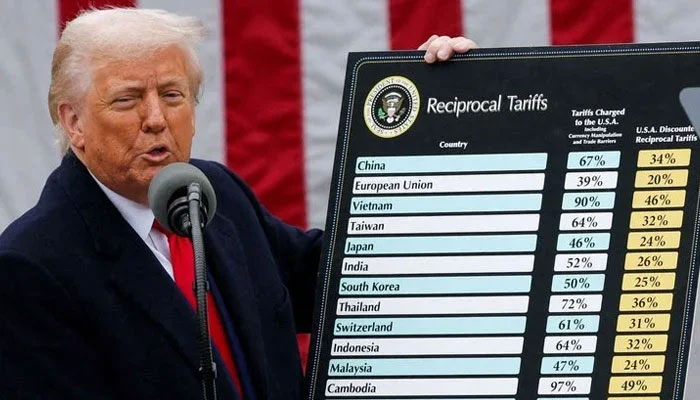
ISLAMABAD: The imposition of reciprocal tariffs by US President Donald Trump on Pakistan’s products might disrupt exportable supplies in the range of $500 to $700 million at the maximum, some initial estimates suggest.
However, many experts consider it an opportunity for Islamabad in case of increased tariffs slapped on regional countries, especially against China. It’s premature to ascertain any exact losses or benefits at this stage but one thing is guaranteed this step will be uncertain and may cause a recession in the US markets.
Dr Safdar Sohail, a former bureaucrat who belonged to the Trade and Commerce group told The News on Tuesday that the US move could be seen as two actions rolled into one: Trade Policy Review of different countries and activation of trade defence laws like anti-dumping, countervailing measures, punitive measures, etc. In routine, these actions would take years through the WTO system. In this case, as there was one country doing this, for the rest of the world they had to be innovative in choosing the yardstick and be quick so that the appellate process kicks for everyone concurrently and at once. Dr Safdar Sohail was of the view that as far as the impact of the reciprocal tariffs on Pakistan is concerned, the assessment of Pakistan Business Council seems very balanced. There is no need for alarm and panic and we should engage our most important bilateral trade partner constructively.
Under an IMF programme with serious external sector vulnerability, Dr Safdar Sohail said we should focus more on giving Pakistan an industrial policy to make the country’s manufacturing competitive and green under a unified framework, benefitting from the IMF Resilience and Sustainability Facility loan. Many of the trade policy issues identified in the diagnostic of Pakistan’s Trade Policy by the US three days ago are real.
Assuaging the Americans on the trade deficit between Pakistan-US should not be very hard because we are not collecting much revenue from the US imports. Nor should it be hard to address most of the US concerns as we are already addressing some with the IMF reforms. The real challenge is to integrate most of these concerns and the EU’s Green concerns in Pakistan’s Green Industrialization Strategy and implement it despite the well-entrenched non-green and unfair commercial practices. We can delay it only at our peril. Our development would suffer more due to our failure on this account than the temporary increase in tariffs by the US, he concluded.






-
 Iran Tensions Rise As Trump Says He Is 'not Thrilled' With Nuclear Negotiations
 -
 Where Is Calvin Klein's Wife Kelly Klein Now After Divorce And Fashion Fame?
 -
 Kourtney Kardashian’s Role As Stepmother Questioned
 -
 Neil Sedaka Dies At 86 After Hospitalisation In Los Angeles
 -
 'Lizzie McGuire' Star Robert Carradine's Reason Of Death Laid Bare
 -
 Lisa Rinna Breaks Silence After Recent Reunion With Andy Cohen: 'I've Pissed Him Off'
 -
 Savannah Guthrie Mom Update: Unexpected Visitors Spark Mystery Outside Nancy's Home
 -
 Elle Fanning Shares Detail About Upcoming Oscars Night Plan With Surprise Date
 -
 Demi Lovato Spills Go-to Trick To Beat Social Anxiety At Parties
 -
 Benny Blanco Looks Back At The Time Selena Gomez Lost Her Handrwritten Vows Days Before Wedding
 -
 Naomi Watts Reveals Why She Won't Get A Facelift In Her 50s
 -
 Travis Kelce's Mom Donna Fires Back At Critic With Sarcastic Reply After Body Jab
 -
 Kendall Jenner Gets Candid About Her Differences With The Kardashian Clan Over Style Choices
 -
 Sam Altman Opens Up About OpenAI, Anthropic, Pentagon Conflict
 -
 Brenda Song Confesses Fascination With Conspiracy Theories
 -
 Lunar Eclipse 2026: Time, Date, Sighting Locations, Know Every Detail