
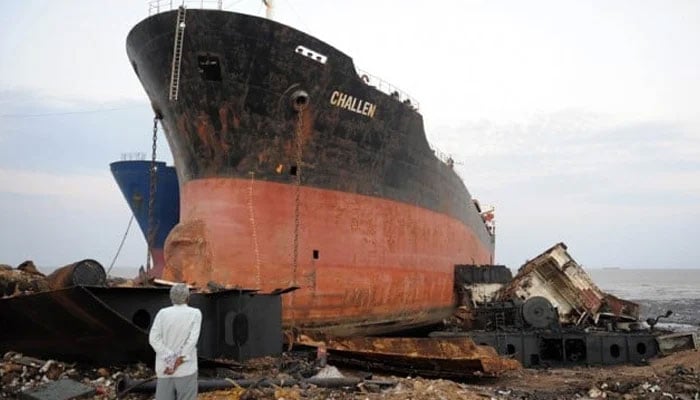
Western countries send ships to Gadani under falsified documents
Islamabad:Rear Admiral Salman Ilyas, Managing Director, Karachi Shipyard, highlighting challenges faced by Pakistan’s shipbuilding industry, has called it an essential but neglected sector crucial for national development.
Admiral Salman was addressing a webinar on "Circularity in the marine environment and sustainable ship recycling in Pakistan" organised here by Sustainable Development Policy Institute.
Admiral Salman said that leading maritime nations like China, US and South Korea leveraged shipbuilding to drive economic sustainability. He said that Pakistan currently lacks class-certified steel manufacturers, a critical requirement for ship construction. Ship structures are complex and cannot be easily dismantled or recycled beyond steel components. Moving machinery, furniture and paint from old ships are not reused, limiting the scope of material recovery. However, steel remains a major recyclable resource with significant potential to contribute to a circular economy if proper certification standards are introduced.
Stressing the need for cleaner shipbuilding processes, he said Karachi Shipyard is implementing measures such as responsible waste management, oil spill control and efficiency-driven manufacturing techniques like water jet cutting.
Dr Abid Qaiyum Suleri, Executive Director, SDPI, highlighted Pakistan’s strategic maritime position and its role in the global recycling value chain through the Gadani shipbreaking industry. Expressing concern over the environmental and labour challenges associated with conventional shipbreaking methods, he said that chemical and oil spills along with hazardous material dumping, is a serious threat to biodiversity as well as local communities. He called for adopting green ship recycling practices to mitigate these impacts.
He also referenced a recent documentary exposing how Western countries illegally send ships to Gadani under falsified documents to avoid their responsibilities in hazardous waste management, violating the Hong Kong Convention and EU Ship Recycling Regulations. Dr Suleri emphasised that Pakistan must find a balance in economic sustainability to adhere to global environmental and safety standards.
Sustainable ship recycling, he said, should be socially inclusive, which must ensure that marginalised communities and women benefit from economic opportunities without being exposed to toxic materials.
Vice-Admiral (retired) Ahmed Saeed, President, National Institute of Maritime Affairs (NIMA), emphasised that transitioning to a circular maritime economy would not only address environmental concerns but also create new employment opportunities, particularly for women. He called for collaboration between policymakers and industry practitioners to close policy gaps and ensure Pakistan remains competitive in the global ship recycling market.
Dr Fasiha Safdar from NIMA said that circularity in marine industries focuses on the reuse and recycling of waste materials to minimise environmental impact. She highlighted that the current linear economic model is responsible for excessive waste and pollution with approximately 11 million tons of plastic entering oceans annually. Circular economy principles, including extended producer responsibility and life cycle analysis offer a path towards sustainability by reducing carbon emissions and enhancing resource efficiency, she opined.
Dr Aneel Salman from IPRI, said that circular economy helps extend material lifecycles, reduces the need for virgin resource extraction and cuts emissions. With 60% of Bangladesh’s steel demand being met through ship recycling, Pakistan has the potential to leverage its own industry for economic and environmental gains.
He added that Pakistan’s Gadani Shipbreaking Yard, which is the third-largest shipbreaking yard in the world, plays a vital role in the global recycling industry. With over 132 shipbreaking plots, it handles a significant portion of the world's decommissioned vessels.
Jawed Iqbal, a representative from the shipbreaking industry, called for stronger regulatory measures and investment in modern recycling facilities. He was of the view that by upgrading infrastructure and adopting advanced dismantling techniques such as plasma arc cutting and high-pressure water jet cutting would enhance operational efficiency, worker safety and environmental sustainability.







-
 Seedance 2.0: How It Redefines The Future Of AI Sector
 -
 Andrew Mountbatten-Windsor Still Has A Loan To Pay Back: Heres Everything To Know
 -
 US House Passes ‘SAVE America Act’: Key Benefits, Risks & Voter Impact Explained
 -
 'Heartbroken' Busy Philipps Mourns Death Of Her Friend James Van Der Beek
 -
 Gwyneth Paltrow Discusses ‘bizarre’ Ways Of Dealing With Chronic Illness
 -
 US House Passes Resolution To Rescind Trump’s Tariffs On Canada
 -
 Reese Witherspoon Pays Tribute To James Van Der Beek After His Death
 -
 Halsey Explains ‘bittersweet’ Endometriosis Diagnosis
 -
 'Single' Zayn Malik Shares Whether He Wants More Kids
 -
 James Van Der Beek’s Family Faces Crisis After His Death
 -
 Courteney Cox Celebrates Jennifer Aniston’s 57th Birthday With ‘Friends’ Throwback
 -
 Camila Cabello Shares Update On Her Hair Two Years After Going Platinum
 -
 Prince William Steps In To Help Farmer's Awareness Mission
 -
 Queen Elizabeth Tied To Andrew's Sexual Abuse Case Settlement: Report
 -
 Mark Ruffalo Urges Fans To Boycott Top AI Company Boycott
 -
 Prince William Joins Esports Battle In Saudi Arabia