
A hard state
Army chief clearly outlined future roadmap that it is inevitable to uproot terrorism to make Pakistan cradle of peace
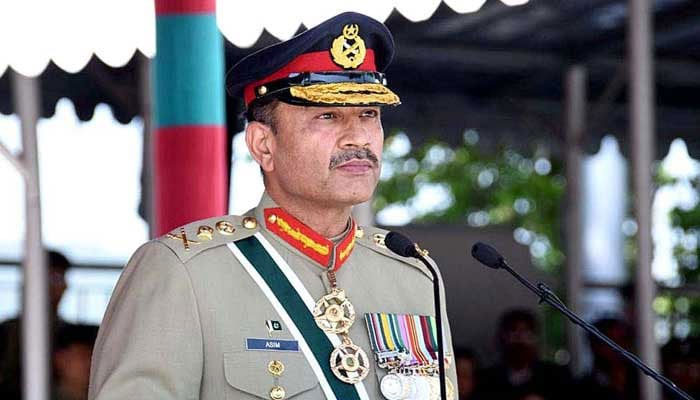
Chief of Army Staff General Asim Munir's determination to transform Pakistan into a hard state has started a new debate on social media. The statement came to light during the National Security Committee meeting held at the Parliament House, in which Prime Minister Shehbaz Sharif, PPP Chairman Bilawal Bhutto Zardari, provincial chief ministers, members of the parliamentary committee and various federal ministers also participated in reviewing the national defence strategy and the ongoing struggle for curbing terrorism.
Earlier, Bilawal Bhutto Zardari, during the National Assembly session, demanded the formulation of National Action Plan II. He emphasised that terrorists, global powers and Pakistan's enemies are taking undue advantage of our differences.
I believe that social media users who are criticising the hard state statement are either not familiar with such terms or they deliberately want to confuse the nation. The term 'soft state' was coined in the sixties by the Swedish researcher and sociologist Gunnar Myderl, who in his book titled 'Asian Drama:
An Inquiry into the Poverty of Nations' blamed soft government policies for the problems faced by various Asian countries, especially India. He highlighted that lax policies, non-implementation of laws and failure to establish the writ of the government lead to the weakening of state institutions, due to which corruption, poverty, bad governance, maladministration and anarchy destabilise the state.
In a soft state, the rise of anti-social elements causes unrest among the people, while neighbouring countries use disgruntled groups as tools to fulfil their interests. People lose trust in the government and feel that the state is failing to protect their lives and property. Similarly, economic uncertainty makes investors, international institutions, the business community and the educated new generation doubtful and forces them to seek opportunities in other stable countries. The soft policies also weaken democratic values and pose new threats to the rule of law, an independent judiciary and a free media.
After the First World War, the soft state of Germany provided a favourable environment for corruption, crime and extremism, which paved the way for the rise of Hitler and the Nazis. Similarly, in the past, soft state policies have been blamed for the instability of various countries including Italy, France, Mexico, Venezuela, Nigeria and Afghanistan. The rise of British imperialism in India was also possible only due to the small soft states of various rajas, maharajas, nawabs and local rulers.
On the other hand, a hard state refers to government policies that are implemented effectively, leading to tangible outcomes and benefits for all citizens without any discrimination. We have examples of China, South Korea, Singapore and the United Arab Emirates. When their leadership transformed their respective countries into Hard States, they emerged as role model states for the entire international community.
At the state level, their leadership ensured that a strict attitude should be taken against anti-social elements involved in social injustice, corruption, discrimination and maladministration. Effective implementation of government policies increases the sense of security for the people, investors and all stakeholders, due to which the goals of development and prosperity are achieved rapidly.
I believe that we should move towards a new National Action Plan II with consensus. In this regard, Bilawal Bhutto Zardari's principled stance is commendable that in a state of war, prioritising the country above politics is a requirement of patriotism for every Pakistani.
The army chief has clearly outlined the future roadmap that it is inevitable to uproot terrorism to make Pakistan a cradle of peace. He rightly stated that nothing is more important than Pakistan's security.
Today, it is very necessary that the people of Pakistan must maintain unity in their ranks. The sacrifices of our brave armed forces should not go in vain. In my view, transforming Pakistan into a hard state would ensure stability, integrity and security, which is essential for economic growth, social development and sustaining peace.
The writer is a member of the National Assembly and patron-in-chief of the Pakistan Hindu Council. He tweets/posts @RVankwani







-
 Fresh Details Of King Charles, Queen Camilla's US Visit Emerge Amid Andrew Investigation
 -
 Iran 'set To Buy' Chinese Carrier-killer Missiles As US Forces Gather In Region
 -
 Prince Harry And Meghan Unlikely To Meet Royals In Jordan
 -
 Hero Fiennes Tiffin Shares Life-changing Advice He Received From Henry Cavill
 -
 Savannah Guthrie's Fans Receive Disappointing News
 -
 Prince William Steps Out For First Solo Outing After Andrew's Arrest
 -
 Jake Paul Chooses Silence As Van Damme Once Again Challenges Him To Fight
 -
 Google Disrupts Chinese-linked Hacking Groups Behind Global Cyber Attacks
 -
 Four People Killed In Stabbing Rampage At Washington Home
 -
 Meghan Pushes Prince Harry Into Territory That’s Dangerous To His Brand: ‘She Isn’t Hearing A Word Of It’
 -
 Christina Applegate Reflects On Lasting Impact Of Being Molested In Childhood
 -
 Martin Short Makes Big Decision Following Tragic Death Of Daughter
 -
 Antarctica’s Mysterious ‘gravity Hole’: What’s Behind The Evolution Of Earth’s Deep Interior?
 -
 Hilary Duff Addresses Ashley Tisdale's 'toxic Mom Group' Claims And Matthew Koma's Firey Response
 -
 Jack Hughes's Proximity To Trump Angers Tate McRae Fans
 -
 Neve Campbell Opens Up About Her 'difficult Decision' To Not Sign 'Scream 6'