
Estimated Rs5.55tr trade discrepancy exposed
These loopholes have allowed manipulations of cargo manifests, declarations and tax assessments
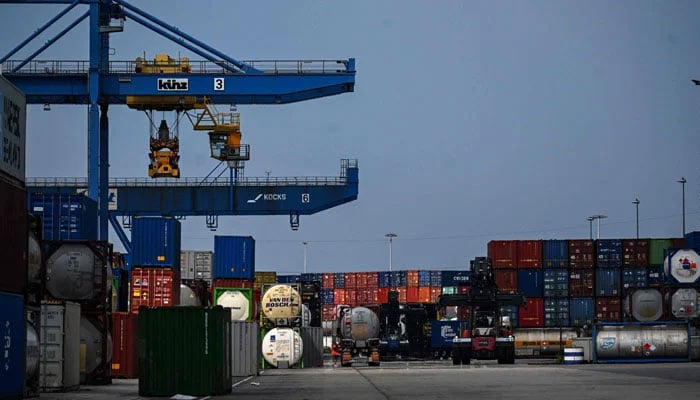
ISLAMABAD: An estimated discrepancy of Rs5.5 trillion has been detected in Pakistan’s trade with China over the past five years due to under-invoicing and exploitation of digital integration gaps at country’s ports.
These loopholes have allowed manipulations of cargo manifests, declarations and tax assessments.
Defence Ministry sources, while referring to the findings of Task Force on Revamping of Maritime Sector, said Pakistan’s port operations are not digitally connected with other countries, leading to massive misdeclarations.
Reportedly, these sources said, data related to “Trade with China” for the last five years shows differences of Rs5.5 trillion as the digital integration voids are being exploited to manipulate the cargo, manifest and the declaration. The figure of Rs5.5 trillion, it is explained, is extrapolated on the basis of sampling data.
The non-digitalisation of the ports processes suppresses the amount of taxes as undervalued prices of goods are declared in many cases. This practice is common on those goods which are subjected to higher taxes, a source said, adding some other areas being exploited for individual gains by corrupt mafia include misdeclarations, manipulation of harmonised system (HS) Codes and lack of integration of systems.
One of the most important issues identified towards revenue shortfall and pilferage is lack of requisite digital connectivity within ports and with FBR and Customs authorities.
Existing Information and Communication Technology (ICT) infrastructure is found by the Task Force as outdated and poorly aligned with key businesses and support functions, leading to reconciliation errors, weak reporting and minimal contributions towards core business of port management adversely effecting maritime economy of the country.
The sources disclosed out of 32 core processes, 11 areas are considered essential for digitisation of ports operation vis-a-vis international best practices, but in the case of KPT and PQA only four and six are digitised.
The essential 11 areas for digitisation include Vessel and Traffic Management, Cargo and Container Management, Yard and Gate Operations, Resource Allocation and Management, Safety/Security/Emergency Management, Environmental Monitoring and Sustainability, Crew and Passenger Management, Infrastructure and Maintenance, Billing/Invoicing/Financial Operations, Communications and Stakeholders Collaboration and Data & Analysis.
In Pakistan’s case, according to sources, declaration of “point of origin” and “goods declaration” is not mandatory at the time of import. This coupled with non-availability of external connectivity and lack of technology-based solutions lead to fake invoicing, misdeclaration (including diplomatic cargo), money laundering, tax evasion, smuggling and misuse of green channel.
Moreover, under-assessment or over-assessment impacts calculation of levied taxes and claiming tax refunds, respectively. To quote a hypothetical example, sources explained, import of “Carbon Steel Pipes”, whose actual value is $0.9 per kilogram, but assessed at $0.69 per kilogram may result in under invoicing of Rs20 million over consignment of 500 tons. In addition, manipulation of HS (Harmonised System) Codes and lack of systems’ provisions aid tax evasion.
For instance, deodorant spray whose actual assessed value is $4.6 per kilogram remains susceptible to under-invoicing amidst assigning different category within the HS Codes to the item due to manipulation or non-updation of the system, leading to under-assessment and evasion of due taxes.
Web-based One Customs (WeBOC) — a system of goods declaration and clearance — is an indigenously developed, web-based computerised clearance system, provides end-to-end automated customs clearance of import and export goods. However, it is an outdated system with obsolete hardware and software configurations. Even the scanners are not integrated digitally into the appraisement system, sources said, adding non-intrusive inspection also remains delinked from the central system, resulting in errors, exploitations and delays.
Financial transactions are also not made digitally through Pakistan Single Window leading to mal-practices and evasion of huge sum of taxes (extrapolated data amounting to trillions of rupees). Host of issues within digitalisation and digital connectivity domains erode investors’ confidence, stifle revenue generation and tax collection.
Manual procedures and absence of technological controls render even gross estimation of incurred losses a daunting challenge, said the sources.







-
 Kanye West's Best Songs: Fans Argue Over Bold Top 10 Ranking On Social Media
 -
 King Charles Secretly Relies On Advice From THIS Royal
 -
 Jennifer Garner Reveals Beauty Choice She Makes As Botox Alternative In Her 50s
 -
 Kate Middleton Drops Four-word Message For Young Girl After Wales Visit
 -
 Shamed Andrew Uncensored ‘massages’ Should Be Refunded To Public
 -
 Kylie Kelce Reveals Rules She Wants Daughter Bennett To Learn At 3: No More 'passies'
 -
 Smartphone Market Set For Biggest-ever Decline In 2026
 -
 Mud, Rain, Loincloths: All About Japan’s 200-year-old Harvest Wrestling Ritual
 -
 Jonathan Majors Set To Make Explosive Comeback To Acting After 2023 Conviction
 -
 Next James Bond: Why Jacob Elordi May Never Get 007 Role?
 -
 Maddox Drops Pitt From Surname In Credits Of Angelina Jolie’s New Film 'Couture' Despite Truce From Father's End In Legal Battle
 -
 Meghan Markle Adds Diamonds To Engagement Ring For Jordan Trip
 -
 Burger King Launches AI Chatbot To Track Employee Politeness
 -
 Andrew’s Woes Amid King Charles’ Cancer Battle Triggers Harry Into Action For ‘stiff Upper Lip’ Type Dad
 -
 Experts Warn Andrew’s Legal Troubles In UK Could Be Far From Over
 -
 Teyana Taylor Reflects On Dreams Turning Into Reality Amid Major Score