
The price of curbing dissent
Curbing dissent through merely enacting new laws is set to become more than just semi-futile
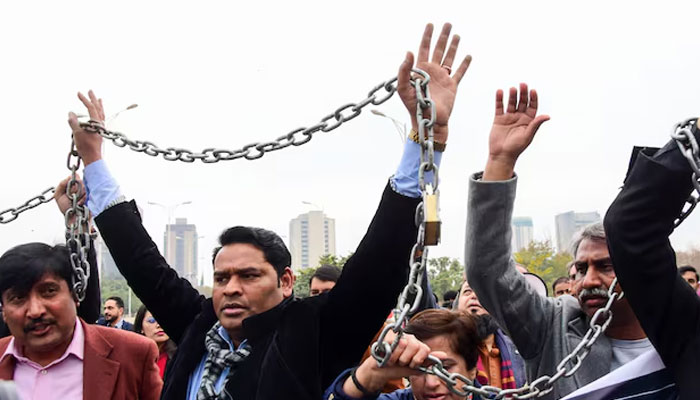
The government’s latest push to prosecute violators of Pakistan’s electronic crimes through fresh laws against electronic crimes runs the risk of yet another failure to curb growing dissent in an increasingly divided country.
As next week Pakistan marks a year since last year’s parliamentary elections, the country’s political divisions have widened an overall division fuelled by politics, a fragmented economy and a society increasingly at risk of a deepening conflict with itself. Meanwhile, Pakistan’s dangerous economic slide downwards remains unattended as the ruling structure led by Prime Minister Shehbaz Sharif fails to undertake deep reforms for the country’s future.
With the incidence of poverty surrounding up to 40 per cent or more of Pakistan’s population, curbing impoverishment should be the singular prime target for any ruling structure. Instead, the current policy direction appears to do little for lifting confidence over the future of reforming Pakistan’s economy.
In this deeply troubled environment, curbing dissent through merely enacting new laws armed with the threat of a heavy fine and a prison term, is set to become more than just semi-futile. Pakistan’s history bears witness to our past era of informal or formal censorship that only coincided with the emergence and growth of a rich culture of rumours and disinformation. In the long term, Pakistan paid a heavy price with its rumours giving birth to disinformation that fuelled deeper divisions than before.
In the 1980s, during the tenure of the late General Ziaul Haq, the much dreaded ‘press advice’ led to the emergence of a parallel system of spreading information. Consequently during the same era, the BBC’s widely popular urdu flagship show ‘Sairbeen’ became a must watch for Pakistanis, increasingly suspicious of home based networks of information.
The same period is remembered more for Pakistan’s historically rich icons of freedom – the late Faiz Ahmed Faiz, fondly remembered as ‘Faiz sahab’, the late Ahmed Faraz and of course the popular poet of the grassroots, Habib Jalib. Together, these and other voices kept up the banner of freedom in the face of one of the darkest periods of oppression in Pakistan’s history. The architects of the dictatorship of the 1980s failed to fathom a writing on the wall: that curbing dissent through the use of force and brutal laws eventually became futile.
Today, the iconic poets of Pakistan have been replaced by other voices of dissent across social media. Curbing such voices through force will eventually provide few success stories in real terms. Instead, the failure of the ruling authorities to provide a convincing story will inevitably just fuel more dissent in an increasingly divided country.
Going forward, Pakistan’s future towards a long overdue period of stabilisation must be preceded by two equally significant undertakings. On the one hand, it is vital to unite Pakistan to face a series of equally profound challenges. This requires actions to overcome divisions across the board. Elements such as ending controversies on a range of fronts, from the mandate of parliament to the role of key institutions in the nation’s functioning, remain central to this endeavour.
In the process, Pakistan must embrace hard choices no matter how inconvenient for the interests of the present-day ruling structure. Unless such divisions are overcome, any new initiative to curb dissent such as enacting harsh new laws are bound to fail. On the other hand, a fresh and unprecedented policy focus on reforming Pakistan is fundamentally essential to the country’s outlook.
In sharp contrast to the focus of the past year under the present government, a fresh direction must be set on the basis of prioritising the needs of mainstream Pakistanis. Unlike the past year, driven by economic development being equated with large commitments for fresh infrastructure projects, a new direction must be led by prioritising food security.
For instance, the ruling structure of today badly let down Pakistan’s farmers a year ago, when a promised rate for the purchase of new stocks of wheat was abruptly withdrawn. Consequently, farmers were forced to sell their stocks of wheat at a price of up to a third below the government’s own promise. The fallout from that tragic event led to the worst financial loss for farmers ever witnessed in Pakistan’s history.
Meanwhile, any student of Pakistan’s economic profile will instantly recognise the dangerous emergence of the country’s increasingly unaffordable domestic and foreign debt. In this very critical environment, there must be no space for criminal largesse such as the planned purchase of more than one thousand cars by the FBR or fresh planned projects such as fanciful train lines or indeed the billions of rupees in large unaccounted expenses for development projects by members of the federal or provincial legislatures.
These choices must be reversed as they are powerful reminders of the areas in need of harnessing Pakistan’s future. Instead, curbing real or imaginary dissent will do little to provide assured security for the country’s future.
The writer is an Islamabad-based journalist who writes on political and economic affairs. He can be reached at: farhanbokhari@gmail.com







-
 Ryan Coogler Shares Thoughts About Building Community Of Actors Amid 'Sinners' Success
 -
 Heidi Klum Gushes Over Diplo Collab 'Red Eye' Despite DJ Falling Asleep During Video
 -
 Israel Behind Majority Of Journalist Deaths Worldwide, Watchdog Claims
 -
 'It Would Become A Circus' : Inside Jane's Turmoil For 'little Sister' Fergie Whose Hidden From The World
 -
 Inside Cardi B's Real Feelings Related To Stefon Diggs Split Post One Year Of Romance
 -
 Former Sri Lankan Intelligence Chief Arrested Over 2019 Easter Bombings
 -
 Kristen Bell Shares One Rule For 'SAG' Awards Ceremony That She Will Ditch This Time: 'Happy And Fun'
 -
 Woman Suing Meta Platforms, YouTube Over Social Media Addiction Sticks To Claims After Trial
 -
 Shakira Applauded For 'gracious' Behaviour By Fans As She Blends Work With Family Downtime
 -
 Mexico’s President Considers Legal Action Over Elon Musk Cartel Remark
 -
 Prince William Hits The Roof With The Andrew Saga Bleeding Into Earthshot
 -
 HBO Gives Major Update About 'Industry' Season Five And Show's End
 -
 Donnie Wahlberg Responds To 'Boston Blue' Backlash: 'Nobody Was More Disappointed Than Me'
 -
 Jennifer Garner Gets Emotional Over Humble Career Start: 'It Makes Me Want To Cry'
 -
 Princess Beatrice Told An Acquaintance That She ‘likes’ Jeffrey Epstein: Grim Verdict Drops
 -
 Late Katherine Short's Neighbours Give Insights Into Her 'peace Loving' Personality Post Suicide