
May 9 convicts being treated as per rules, SC told
Total 28 convicts of which one had been released and now 27 convicted persons were at Kot Lakhpat Jail, reads Punjab govt report
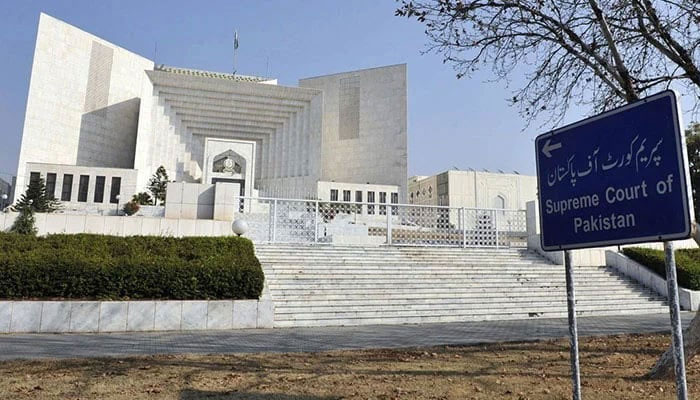
ISLAMABAD: The Punjab government Wednesday informed the Constitutional Bench that all the persons convicted by the military courts for May 9 violence were being dealt with in accordance with the Pakistan Prisons Rules 1978.
A seven-member bench of the Constitutional Bench — headed by Justice Amin-ud-Din Khan — heard the intra court appeals (ICAs) of the federal government against the apex court judgment declaring the trial of civilians in military courts unconstitutional.
Justice Jamal Khan Mandokhel, Justice Muhammad Ali Mazhar, Justice Syed Hassan Azhar Rizvi, Justice Musarrat Hilali, Justice Naeem Akhtar Afghan and Justice Shahid Bilal Hassan were the bench members.
In pursuance of the Constitutional Bench’s order passed on Tuesday, Additional Advocate General Punjab Waseem Mumtaz submitted a report to the bench stating that there were 28 convicts of which one had been released and now 27 convicted persons were at the Kot Lakhpat Jail.
The convicted prisoner, Muhammad Bilawal, was released on January 2, as his remaining sentence was pardoned by the army chief and orders were communicated through Syed Muhammad Hamayun Iftikhar, Lieutenant Colonel Assistant Judge Advocate General Rawalpindi.
It was stated that at the time of admission to jail, medical screening and examination of all the convicted prisoners were made by the medical officer, adding that hot and hygienic food was served three times a day as per the official menu.
Likewise, interview facility was availed by all the prisoners without any hurdle.
The report further stated that on the day of interview, the family members were also allowed to bring home food, fruits and other permitted eatable items.
It was further stated that an outlet of Utility Stores Corporation of Pakistan had also been established in the jail’s waiting shed and the inmates were at liberty to place orders at their own expense.
Similarly, the medical staff is available round the clock to address any medical issue.
Hafeez Ullah Khan Niazi, father of Hassam Khan Niazi who was also sentenced to 10-year imprisonment, told the bench that although family members were being allowed to meet him, people other than father, mother brother and sisters were not being allowed.
Justice Amin observed that if there was any problem, they will resolve it.
“It is very difficult for anyone to remain in jail cell alone even for two days,” Justice Jamal Khan Mandokhel said, adding that as a lawyer, he himself had spent 14 days in jail.
“After Fajr prayer, they were allowed to spend time in an open area adjacent to the jail cell, while some prisoners used to play games,” Justice Mandokhel added.
At this, Justice Muhammad Ali Mazhar with smilingly replied to the judge that he might have got special concession.
Additional Advocate General Punjab Waseem Mumtaz also recalled that he and Justice Shahid Bilal Hassan had remained collectively at the Bahawalpur Jail.
Justice Muhammad Ali Mazhar asked the law officer to allow the prisoners to enjoy sunlight. The law officer assured the court to do so.
Earlier, Khwaja Haris, counsel for the defense ministry, continued his arguments.
Reading out the judgment declaring the trial of civilians in military courts as unconstitutional, he contended that the majority decision had misinterpreted Article 8(3) and 8(5) of the Constitution.
He submitted that the Supreme Court in FB Ali case had held that civilians could also be tried in military courts. He contended that the interpretation wrongly suggested that the FB Ali case was of a different nature.
Khwaja Haris submitted that Brigadier FB Ali was tried after retirement when he was a civilian adding that the decision stated FB Ali had not retired at the time of the offence, making his case unique.
Justice Jamal Khan Mandokhel, however, observed that the accused in the current case linked to the events of May 9, had no connection to the armed forces.
Justice Mandokhel added that nowadays, there is a term ‘ex-servicemen,’ but these individuals weren’t even ex-servicemen but just civilians.
Whether civilians could be tried under the Army Act or not and whether this applies only to specific citizens,” Justice Mandokhel asked Haris.
The counsel replied that the general perception was different to which Justice Mandokhail urged the counsel to ignore the public opinion and directly address whether civilians could be tried in military courts.
Similarly, Justice Musarrat Hilali asked the counsel whether all fundamental rights would be suspended when the Army Act was applied.
Justice Mohammad Ali Mazhar talked about the international practice and asked Haris if he had any examples to provide. Haris replied in the affirmative saying he will tell the court later on.
Justice Mandokhel observed that lots of our young soldiers had embraced martyrdom and asked the counsel whether the attackers would also be tried in military courts.
Justice Musarrat Hilali observed that military trials were designed for culprits in cases like the Army Public School (APS) tragedy and questioned whether the same approach could be applied to all civilians.
He further observed that the Constitution was not suspended.
Haris replied that the fundamental rights always existed and decisions of the apex court in this regard were in the field.
Justice Mandokhel observed that the basic question was as to which cases under Article 8, Section 3 would be eligible for trial in military courts.
Justice Naeem Akhtar Afghan observed that the apex court’s five-member bench had set aside some of provisions of the Army Act.
“If we also set aside those provisions, then civilians would not be tried in military courts,” Justice Afghan remarked saying if the Constitutional Bench reached another result, then it will settle as to which civilian could be tried in a military court.
Justice Naeem Akhtar Afghan further observed that in 2023, an amendment had been made to the Official Secret Act asked the counsel to inform the bench in light of that amendment.
Justice Afghan further said Justice Jamal Khan Mandokhel had asked the question while citing an example of an army checkpoint.
At this, Justice Jamal Khan Mandokhel observed that parliament was competent to make legislation and the Constitution empowered in this regard. Later, the court adjourned the hearing for today (Thursday). Khwaja Haris will continue his arguments.







-
 Prince Harry And Meghan Unlikely To Meet Royals In Jordan
 -
 Hero Fiennes Tiffin Shares Life-changing Advice He Received From Henry Cavill
 -
 Savannah Guthrie's Fans Receive Disappointing News
 -
 Prince William Steps Out For First Solo Outing After Andrew's Arrest
 -
 Jake Paul Chooses Silence As Van Damme Once Again Challenges Him To Fight
 -
 Google Disrupts Chinese-linked Hacking Groups Behind Global Cyber Attacks
 -
 Four People Killed In Stabbing Rampage At Washington Home
 -
 Meghan Pushes Prince Harry Into Territory That’s Dangerous To His Brand: ‘She Isn’t Hearing A Word Of It’
 -
 Christina Applegate Reflects On Lasting Impact Of Being Molested In Childhood
 -
 Martin Short Makes Big Decision Following Tragic Death Of Daughter
 -
 Antarctica’s Mysterious ‘gravity Hole’: What’s Behind The Evolution Of Earth’s Deep Interior?
 -
 Hilary Duff Addresses Ashley Tisdale's 'toxic Mom Group' Claims And Matthew Koma's Firey Response
 -
 Jack Hughes's Proximity To Trump Angers Tate McRae Fans
 -
 Neve Campbell Opens Up About Her 'difficult Decision' To Not Sign 'Scream 6'
 -
 Nobel-winning Scientist Resigns From Columbia University After Epstein Links Revealed
 -
 Prince William Remarks At BAFTAs 'indicative' Of King Charles Physical, Mental Health Too