
The hydro heritage of Swat
Joyous gatherings, poetic expressions, and cultural rituals that revolved around water are now echoes of distant past
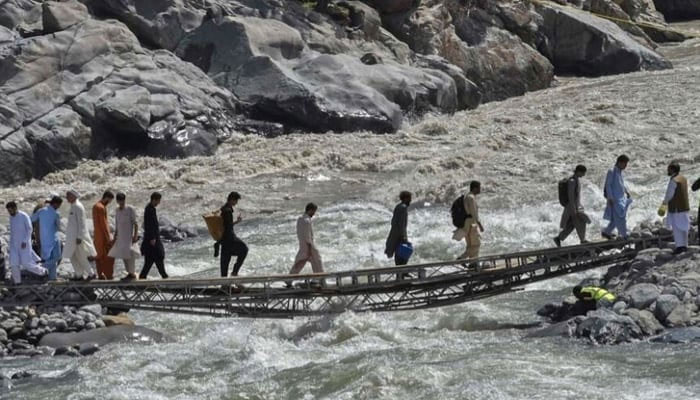
The Swat Valley, nestled in the northern mountains of Pakistan, is not merely a geographical marvel; it is a cradle of cultural, emotional, and natural heritage that flows through its lifeblood – water.
Springs, streams, rivers, glaciers, canals, waterfalls, and lakes are not just reservoirs of water but sources of what is now called ‘hydro-heritage’. These water bodies are deeply embedded in Swat's identity, carrying with them the culture, emotions, poetry, music, and timeless stories of love, longing, and community.
The very name ‘Swat’ is derived from its river. Swat is not a town, village, or city; it is the name of the river that originates from glaciers and lakes high up in the mountains. Flowing through the valley, this river nourishes Swat's culture, shapes its history, and gives life to its natural beauty before merging with the Kabul River. It is this river and its tributaries – springs, canals, and streams – that breathe life into the valley’s literature, music, and folklore. Without them, the Pashto, Torwali, Gujri, and Gawri poetry of Swat would lose its rhythm, and the folk tales that define its people would remain incomplete.
In Torwali, the term ‘Guthur’, and in Pashto ‘Godar’, refers to springs and gathering spots. These were not merely utilitarian spaces for fetching water but vibrant cultural and social hubs. Women gathered here with their earthen pots – mangai, matka, and bheden – not just to collect water but to share stories, songs, and laughter. The clay pots were often brimming with the joys and exuberance of youth, reflecting the unbridled vitality of the women who carried them.
These springs, like the water that gushed forth from rocky crevices, were places where restrained emotions burst forth, defying the constraints of tradition. Women found moments of freedom here, as these springs doubled as spaces of leisure and recreation. In the evenings, when women dressed in vibrant shawls gathered around the mountain springs, the scene was like an artwork – a kaleidoscope of colour and life, resembling golden birds gathered around a rocky stream.
The folk poetry of Swat captures these moments of beauty. For instance, this Torwali couplet: “theye kaan o bhardan gheeni Mahmad Zahir Shah/ bash guthur kay bi bi lakman si bheden phara” ["If Muhammad Zahir Shah were alive, I’d hand him a slingshot,/ And he’d break the clay pot of that beauty at the mountain spring."]
And this Pashto couplet: “che mazigar patey khaisata kegi/ mangay naray warta wahi godar la zeena” [“As the evening sets in, the clay pot calls out to her, inviting her to the spring. Thus, the evening becomes beautiful”].
And this Torwali couplet brings forth the metaphor of mountain spring for the human yearning so beautifully. “aa sey uus thu nukhodu tey kisjan paheema/ chi misaal tisjael si yede pu engola” [“I am like the spring that springs from black ice./ O friend, come to me and quench your thirst.”]
Or this one: “guup nhigaado ghen nhed taliye waed kashmala/ mae hisaab ki qawar mi chi tilen hi pura” [“When Sirius rose, River Swat reduced to its bed/ I counted and one year passed since you died my love!”]
With the arrival of ‘Pakistani modernity’, a harsh, unfeeling form of development swept across Swat. This modernity prioritised concrete and cement over culture, beauty and history. It dismantled Swat’s hydro-heritage, reducing vibrant and soulful spaces to mere utilities. The poetry, emotions, and delicate balance between nature and human life were sacrificed at the altar of ‘progress’.
First came conflict, as the Taliban insurgency ravaged the valley, uprooting its cultural and social fabric. Then came state-led reconstruction, marked by a militarised form of development. Infrastructure projects – roads, pipelines, and modern water systems – were introduced under the guise of progress. Traditional springs were dried up, and springs were diverted into plastic pipes.
The social fabric of the villages was transformed. Access to water became politicised, with pipes distributed as political favours. Those who secured pipes from councillors or MPs became influential figures in the village, while those who could not were left marginalised. Community bonds, once strengthened by shared spaces like springs, began to fracture.
The springs of Swat were particularly significant for women. These were spaces where they could gather, socialise, and enjoy moments of leisure. But modernisation, coupled with increasing societal restrictions, has severely curtailed women’s access to these spaces.
Religious spaces built directly over or near springs have created barriers. These spaces are male-dominated, and their presence has alienated women from their traditional gathering spots. Springs, once vibrant with the chatter and laughter of women, are now silent. For many women, these changes symbolise not just the loss of access to water but the loss of freedom and social connection.
This alienation is poignantly reflected in the words of a local woman: "I used to feel my heart open when I visited the spring with my friends. Now, I’m told, 'You will not go there’. The spring, and the joy it brought, is gone."
Adding to this loss is the impact of hydropower projects. Under the banner of ‘clean and renewable energy’, these projects have disrupted Swat’s delicate ecosystem. One hydropower project, for instance, has dried up dozens of springs and erased traditional gathering spots. Massive projects along the Swat River, from Madyan to Kalam and Gabral, are diverting water through tunnels, threatening not just the river but also the springs that depend on its flow.
What were once vibrant spaces of hydro-heritage – sites of healing, sociability, and cultural expression – have been reduced to mere water sources. Springs, once intertwined with local myths, spirituality, and cultural practices, have been stripped of their emotional and historical significance. This shift symbolises a broader erosion of Swat’s identity, as traditions tied to water fade into memory.
The loss of Swat’s hydro-heritage is not just physical; it is a cultural, emotional, and spiritual tragedy. Springs that once united communities and symbolised the valley’s soul have been replaced by lifeless infrastructure. The joyous gatherings, poetic expressions, and cultural rituals that revolved around water are now echoes of a distant past.
To heal Swat, its hydro-heritage must be reclaimed. Springs and water bodies must be restored as vibrant cultural spaces beyond utilitarian value. Only by reconnecting with this heritage can Swat revive its lost essence and rediscover the soul that once flowed through its rivers, streams, and springs.
The writer heads an independent organisation dealing with education and development in Swat. He can be reached at: ztorwali@gmail.com







-
 Kanye West's Last Measure To Save Bianca Censori Marriage As He Tries To Salvage Image
 -
 Kim Kardashian Finally Takes 'clear Stand' On Meghan Markle, Prince Harry
 -
 Christina Applegate Makes Rare Confession About What Inspires Her To Keep Going In Life
 -
 Patrick J. Adams Shares The Moment That Changed His Life
 -
 Selena Gomez Getting Divorce From Benny Blanco Over His Unhygienic Antics?
 -
 Meet Arvid Lindblad: Here’s Everything To Know About Youngest F1 Driver And New Face Of British Racing
 -
 At Least 30 Dead After Heavy Rains Hit Southeastern Brazil, 39 Missing
 -
 Courtney Love Recalls How ‘comparison’ Left Marianne Faithfull ‘broken’
 -
 Pedro Pascal Confirms Dating Rumors With Luke Evans' Former Boyfriend Rafael Olarra?
 -
 Ghost's Tobias Forge Makes Big Announcement After Concluding 'Skeletour World' Tour
 -
 Katherine Short Became Vocal ‘mental Illness’ Advocate Years Before Death
 -
 SK Hynix Unveils $15 Billion Semiconductor Facility Investment Plan In South Korea
 -
 Buckingham Palace Shares Major Update After Meghan Markle, Harry Arrived In Jordan
 -
 Demi Lovato Claims Fans Make Mental Health Struggle Easier
 -
 King Hospitalized In Spain, Royal Family Confirms
 -
 Japan Launches AI Robot Monk To Offer Spiritual Guidance