
NASA probe makes closest ever pass by the Sun
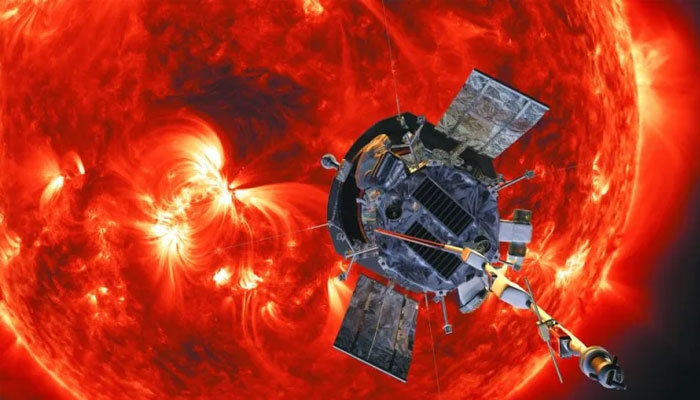
WASHINGTON: NASA´s pioneering Parker Solar Probe made history Tuesday, flying closer to the Sun than any other spacecraft with its heat shield exposed to scorching temperatures of more than 1,700 degrees Fahrenheit (930 degrees Celsius).
Launched in August 2018, the spaceship is on a seven-year mission to deepen scientific understanding of our star and help forecast space-weather events that can affect life on Earth.
Tuesday´s historic fly-by should have occurred at precisely 6:53am (1153 GMT), although mission scientists will have to wait until Friday for confirmation as they lose contact with the craft for several days due to its proximity to the Sun.
If the distance between Earth and the Sun is the equivalent to the length of an American football field, the spacecraft should have been about four yards (meters) from the end zone at the moment of closest approach - known as perihelion.
“This is one example of NASA´s bold missions, doing something that no one else has ever done before to answer longstanding questions about our universe,” Arik Posner, Parker Solar Probe program scientist said in a statement on Monday.
“We can´t wait to receive that first status update from the spacecraft and start receiving the science data in the coming weeks.”
So effective is the heat shield, that the probe´s internal instruments remain near room temperature — around 85F (29C) — as it explores the Sun´s outer atmosphere, called the corona.
Parker will also be moving at a blistering pace of around 430,000 mph (690,000 kph), fast enough to fly from the US capital Washington to Tokyo in under a minute.
“No human-made object has ever passed this close to a star, so Parker will truly be returning data from uncharted territory,” said Nick Pinkine, mission operations manager at the Johns Hopkins Applied Physics Laboratory (APL) in Laurel, Maryland. “We´re excited to hear back from the spacecraft when it swings back around the Sun.” By venturing into these extreme conditions, Parker has been helping scientists tackle some of the Sun´s biggest mysteries: how the solar wind originates, why the corona is hotter than the surface below, and how coronal mass ejections — massive clouds of plasma that hurl through space — are formed.







-
 Mexico’s President Considers Legal Action Over Elon Musk Cartel Remark
 -
 Prince William Hits The Roof With The Andrew Saga Bleeding Into Earthshot
 -
 HBO Gives Major Update About 'Industry' Season Five And Show's End
 -
 Donnie Wahlberg Responds To 'Boston Blue' Backlash: 'Nobody Was More Disappointed Than Me'
 -
 Jennifer Garner Gets Emotional Over Humble Career Start: 'It Makes Me Want To Cry'
 -
 Princess Beatrice Told An Acquaintance That She ‘likes’ Jeffrey Epstein: Grim Verdict Drops
 -
 Late Katherine Short's Neighbours Give Insights Into Her 'peace Loving' Personality Post Suicide
 -
 Fresh Details Of King Charles, Queen Camilla's US Visit Emerge Amid Andrew Investigation
 -
 Iran 'set To Buy' Chinese Carrier-killer Missiles As US Forces Gather In Region
 -
 Prince Harry And Meghan Unlikely To Meet Royals In Jordan
 -
 Hero Fiennes Tiffin Shares Life-changing Advice He Received From Henry Cavill
 -
 Savannah Guthrie's Fans Receive Disappointing News
 -
 Prince William Steps Out For First Solo Outing After Andrew's Arrest
 -
 Jake Paul Chooses Silence As Van Damme Once Again Challenges Him To Fight
 -
 Google Disrupts Chinese-linked Hacking Groups Behind Global Cyber Attacks
 -
 Four People Killed In Stabbing Rampage At Washington Home