
Syrian rebels took a year to plan Assad’s ouster: report
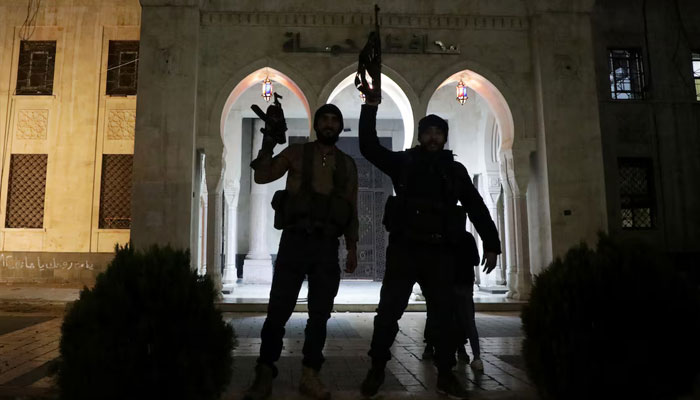
LONDON: Syria´s Islamist-led rebel alliance had been planning the surprise ouster of President Basher al-Assad for a year, an opposition military leader told the Guardian in an interview published on Friday.
The Hayat Tahrir al-Sham (HTS) Islamist group, which says it has moved away from its roots in al-Qaeda, has long-controlled a part of northwest Syria.
After being weakened in a 2019 government operation, the group realised the “fundamental problem was the absence of unified leadership and control over battle”, Abu Hassan al-Hamwi, an HTS commander and former leader of the group´s military wing, told the UK daily.
Correcting those mistakes, HTS began last year preparing for a retaliatory operation dubbed “Deterring Aggression” to oust Assad.
It strengthened its control over opposition groups in the northwest and trained up its own militia, developing a “comprehensive military doctrine”.
HTS then tried to bring together rebel and jihadist forces in southern Syria, under Assad´s control for the past six years, to create a “unified war room”, according to the Guardian article.
The “war room” convened commanders of 25 opposition groups who could steer the offensive against Assad from the south, with HTS driving in from the north, and converging in the capital and Assad´s stronghold Damascus.
The moment to launch the operation came in late November, with Syria´s staunch allies Iran and Russia distracted by other conflicts.
Over the weekend, the rebels succeeded in entering Damascus after sweeping through the cities of Aleppo, Hama and Homs in the north, causing Assad to flee the country and ending five decades of brutal rule by his clan.
“We had a conviction, supported by historical precedent: that ´Damascus cannot fall until Aleppo falls´”, Hamwi said.
“The strength of the Syrian revolution was concentrated in the north, and we believed that once Aleppo was liberated, we could move southward toward Damascus,” he added.
The plan also involved developing better weapons to counter the technology Tehran and Moscow provided to the government forces.
“We needed reconnaissance drones, attack drones and suicide drones, with a focus on range and endurance,” Hamwi said, with drone production beginning as early as 2019.
Hamwi named a new exploding or “suicide drone” the “Shahin” drone, meaning falcon in Arabic, which “symbolised their precision and power”, the military leader said.
The “Shahin” drone was deployed for the first time against Assad´s forces this month, according to the Guardian, disabling artillery vehicles.
“We affirm that minorities in Syria are part of the nation and have the right to practice their rituals, education, and services like every other Syrian citizen,” Hamwi said.
“The regime planted division, and we are trying, as much as possible, to bridge these divides,” he added.







-
 Prince William Steps In To Help Farmer's Awareness Mission
 -
 Queen Elizabeth Tied To Andrew's Sexual Abuse Case Settlement: Report
 -
 Mark Ruffalo Urges Fans To Boycott Top AI Company Boycott
 -
 Prince William Joins Esports Battle In Saudi Arabia
 -
 Princess Beatrice, Eugenie Are Being Ripped Apart: ‘Their Relationship Is Fully Fractured’
 -
 Arden Cho Shares Update On Search For ‘perfect’ Wedding Dress Ahead Of Italy Ceremony
 -
 Ariana Madix Goes Unfiltered About Dating Life
 -
 Prince William Closes Saudi Arabia Visit With Rare Desert Shot
 -
 Priyanka Chopra Breaks Silence On Rumors Questioning Marriage To Nick Jonas
 -
 'King Charles Acts Fast Or Face Existential Crisis' Over Andrew Scandal
 -
 Brooklyn Beckham Charging Nearly £300 In Ticket Cost For Burger Festival
 -
 Prince William Makes Unexpected Stop At Local Market In Saudi Arabia
 -
 Zayn Malik Shares Important Update About His Love Life
 -
 James Van Der Beek's Celebrity Pals Pen Touching Tribute After His Death
 -
 Kate Middleton, William Are Holding Onto Their Hats As Worse Gets Threatened: Behind The Veil Of Shame
 -
 British Soap Awards Scrapped Again As ITV Confirms 2026 Hiatus