
Unsustainable farming, forest loss driving Earth to ‘precipice’: UN
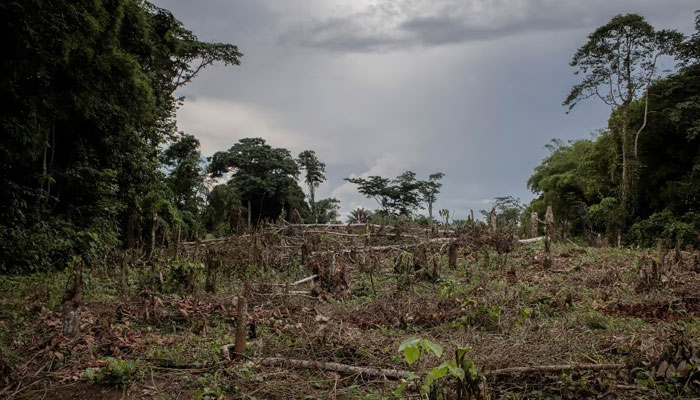
PARIS: Unsustainable farming and deforestation are threatening the planet´s capacity to sustain human societies, the UN warned on Sunday, on the eve of international talks on land degradation and desertification.
Forest loss and degraded soils are reducing resilience to climate change and biodiversity loss, creating negative feedback loops and driving the world to a dangerous “precipice”, scientists said in a report jointly released with the UN Convention to Combat Desertification (UNCCD).
It comes as nearly 200 nations are expected to gather in Saudi Arabia for the UN desertification summit on Monday tasked with expanding restoration efforts to restore 1.5 billion hectares of degraded land this decade.
The meeting is expected to be the largest conference on land to date and comes in the wake of a clutch of tough-fought UN negotiations on climate, biodiversity and plastics.
“If we fail to acknowledge the pivotal role of land and take appropriate action, the consequences will ripple through every aspect of life and extend well into the future, intensifying difficulties for future generations,” said UNCCD Executive Secretary Ibrahim Thiaw.
The new report highlights the heavy burden agriculture places on the planet and calls for a course correction.
Farming is linked to 23 percent of greenhouse gas emissions, 80 percent of deforestation and 70 percent of freshwater use.
“The expansion of agricultural land may feed more people in the short term, but it can accelerate soil degradation, biodiversity loss, and thus food insecurity in the long term,” said Thiaw and Johan Rockstrom at the Potsdam Institute for Climate Impact Research in the foreword.
Beyond driving forest loss, industrialised agriculture uses huge quantities of chemicals in fertilisers and pesticides that create dead zones in waterways, harm biodiversity and increase emissions of planet-heating gases.
Poor water management also depletes freshwater resources.
Drawing on 350 sources of research, the report uses the concept of planetary boundaries, the “safe operating space” for keeping the world liveable for most species.
“The aim of the planetary boundaries framework is to provide a measure for achieving human wellbeing within Earth´s ecological limits,” said Rockstrom.
“We stand at a precipice and must decide whether to step back and take transformative action, or continue on a path of irreversible environmental change,” he adds.
Six of nine of these boundaries -- climate change, deforestation, biodiversity loss, synthetic chemicals including plastics, freshwater depletion and nitrogen use -- are already deep in the red.
Two of the remaining three -- ocean acidification along with the concentration of particle pollution and dust in the atmosphere -- are borderline, with only ozone depletion comfortably within safe bounds. The report warned of accelerating feedback loops.
Deforestation for example causes carbon emissions that worsen climate change, but forest loss also reduces the ability of the ecosystem to recycle water and cope with drought causing more trees to die.
Solutions include tackling corruption, improving water management and agriculture reform.
The report also recommended realigning hundreds of billions of dollars in harmful or inefficient agricultural subsidies with more sustainable farming practices.
According to data shared with UNCCD by governments, land degradation affects an area of 1.5 billion hectares -- nearly the size of Russia. And the area is increasing by an estimated 100 million hectares every year.
In an interview with AFP, Thiaw said “global security is really at stake”, with forest loss and impoverished soils driving hunger, conflict and migration.
Saudi Arabia´s high oil production routinely draws the ire of climate activists and accusations of efforts to undermine progress at other UN environment meetings.
But its exposure to desertification gives Riyadh a greater stake in a positive outcome at the 12-day talks.
The country, home to one of the world´s largest deserts, aims to restore 40 million hectares of degraded land, deputy environment minister Osama Faqeeha told AFP, without specifying a timeline.







-
 Why Kate Middleton, Prince William Opt For ‘show Stopping Style’
 -
 Here's Why Leonardo DiCaprio Will Not Attend This Year's 'Actors Award' Despite Major Nomination
 -
 Ethan Hawke Reflects On Hollywood Success As Fifth Oscar Nomination Arrives
 -
 Tom Cruise Feeling Down In The Dumps Post A Series Of Failed Romances: Report
 -
 'The Pitt' Producer Reveals Why He Was Nervous For The New Ep Of Season Two
 -
 Maggie Gyllenhaal Gets Honest About Being Jealous Of Jake Gyllenhaal
 -
 'Bridgerton' Star Luke Thompson Gets Honest About Season Five
 -
 Prince William On Verge Of Breakdown Because Of 'disgraced' Andrew
 -
 Tig Notaro Reflects On Oscar Nod For 'Come See Me In The Good Light': 'I Was Sleeping'
 -
 Kenyon Sadiq Sets 40-yard Dash Record At NFL Scouting Combine, Eyes First Round
 -
 Talk Show Host Drops Hint About Taylor Swift, Travis Kelce Wedding Date
 -
 Andrew Scandal Brings New Worries For Prince Harry, Meghan Markle
 -
 King Charles Imposes New Restrictions On Ex-Prince Andrew In Surprise Move
 -
 Chris Hemsworth Reveals How Elsa Pataky Guides His Career Moves
 -
 Was Travis Barker In A Relationship With Kim Kardashian Before Marrying Her Sister?
 -
 Brad Pitt Feeling Down In The Dumps After Kids' Snubs As Pals Continue To Paint Angelina Jolie A Villain