
Lawyers challenge 26th amendment in SHC
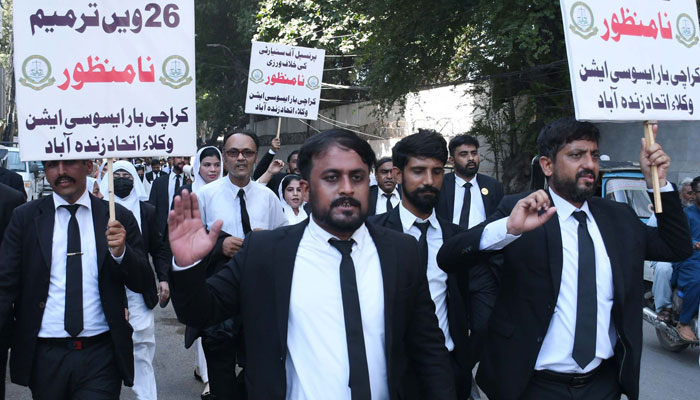
A Sindh Bar Council member and the president of the Malir Bar Association has challenged different sections of 26th Constitutional Amendments in the Sindh High Court.
Petitioner Mohammad Ashraf Sammi and MBA President Nasir Raza submitted that the parliament enacted 26th amendment in the constitution which violates the principles of separation of power, judicial independence and rule of the law.
They said the impugned amendments drastically undermine the authority of the Supreme Court of Pakistan and the high courts by transferring constitutionally vested powers to some new constitutional benches unknown to the basic structure of the constitution.
The petitioners’ counsel Ali Tahir submitted that the amendment contemplates selection of chief justice from a panel of three senior most judges of the SC which is to be done by the special parliamentary committee, which is a clear attack on the independence of the judiciary and an attempt to undermine and control independence of the judges.
The counsel also questioned independence of casting of votes by the members of the parliament and submitted that if the court observed that two members of either house did not freely exercise their right of vote, the 26th amendment will be procedurally invalid and liable to be struck down.
He submitted that the parliament made an amendment in the 175 (A) (2) in which greater interference is allowed by the executive over the appointment of Supreme Court judges and judicial commission shall be composed of CJP, three senior judges of the SC, most senior judge of the constitutional bench, federal minister of law, attorney general of Pakistan, an advocate nominated from Pakistan Bar Council, two members from Senate, two members from National Assembly and a woman or non-Muslim other than a member of Majlis-e-Shoora who is qualified to be member of the Senate as technocrat to be nominated by the speaker National Assembly.
He submitted that an increased non-judicial and political influence/interference in the appointment of judges may lead to compromising judicial independence and is contrary to the principle of trichotomy of powers.







-
 Andrew, Sarah Ferguson Refuse King Charles Request: 'Raising Eyebrows Inside Palace'
 -
 Adam Sandler Reveals How Tom Cruise Introduced Him To Paul Thomas Anderson
 -
 Washington Post CEO William Lewis Resigns After Sweeping Layoffs
 -
 North Korea To Hold 9th Workers’ Party Congress In Late February
 -
 All You Need To Know Guide To Rosacea
 -
 Princess Diana's Brother 'handed Over' Althorp House To Marion And Her Family
 -
 Trump Mobile T1 Phone Resurfaces With New Specs, Higher Price
 -
 Factory Explosion In North China Leaves Eight Dead
 -
 Blac Chyna Opens Up About Her Kids: ‘Disturb Their Inner Child'
 -
 Winter Olympics 2026: Milan Protestors Rally Against The Games As Environmentally, Economically ‘unsustainable’
 -
 How Long Is The Super Bowl? Average Game Time And Halftime Show Explained
 -
 Natasha Bure Makes Stunning Confession About Her Marriage To Bradley Steven Perry
 -
 ChatGPT Caricature Prompts Are Going Viral. Here’s List You Must Try
 -
 James Pearce Jr. Arrested In Florida After Alleged Domestic Dispute, Falcons Respond
 -
 Cavaliers Vs Kings: James Harden Shines Late In Cleveland Debut Win
 -
 2026 Winter Olympics Snowboarding: Su Yiming Wins Bronze And Completes Medal Set