
‘Quaid-e-Azam’s August 11 speech should be made part of constitution’
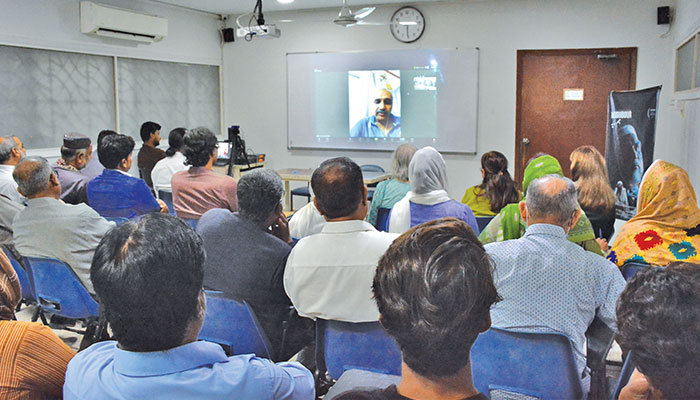
The Centre for Social Justice, in collaboration with Szabist University, held a screening of the documentary Hum Saya (Neighbour) on Wednesday.
The documentary, produced by the Centre for Social Justice, has received the award for ‘Best Short Documentary on Human Rights’ at the prestigious Venice Intercultural Film Festival 2023. It is based on true stories, particularly in the context of the recent rise in extremism, killings in the name of blasphemy, and forced conversions in Pakistan.
A discussion followed the screening. Szabist’s Dr Riaz Ahmed Shaikh emphasised that the August 11 speech of the Quaid-e-Azam should be made part of the constitution. “The state should prosecute the culprits involved in the market incident. This will have a positive impact. The curriculum should be secularised,” he said.
Civil rights activist Ahsan Khan stated that the state plays the biggest role in enabling religious extremism in Pakistan. He said the treatment once meted out to Muslims before Partition is now being inflicted upon non-Muslims after Partition. He lamented that if even those from powerful quarters fear speaking about minorities, how religious minorities themselves can raise their voices for their rights.
He added that when the late Salman Taseer, a member of the progressive political party Pakistan Peoples Party (PPP), was assassinated, even the PPP avoided publicly addressing the issue. He criticised Pakistan Tehreek-e-Insaf (PTI) chief Imran Khan “for using religion for political gain”.
Khan further alleged that after General Zia-ul-Haq, Imran Khan is the most powerful leader to have used religion as a political tool. “He is responsible for fostering religious extremism in Pakistan,” he said.
Anita Panjani highlighted that forced conversion is a highly sensitive issue in Pakistan, with strong political implications. She echoed Ahsan Khan’s sentiments, pointing out that all three major political parties — PTI, PPP and Pakistan Muslim League-Nawaz (PML-N) —have failed to separate religion from state affairs.
Panjani said that citizens of Pakistan should not be considered minorities. “The term ‘religious minority’ can be used, but they should not be treated as second-class citizens,” she said, adding that non-Muslims, being born in Pakistan, should not be labelled as minorities.
The Muttahida Qaumi Movement’s (MQM) minority wing leader, Shahid Bhatti Advocate, shared his experience fighting forced conversion cases. He stated that culprits were convicted in cases where the victim’s testimony was strong. He stressed the need to strengthen prosecution in such cases.
Another civil rights activist, Nasima, argued that religious harmony and tolerance must be promoted in the school curriculum. She lamented that the curriculum has been deliberately altered to spread hatred.







-
 Kanye West's Last Measure To Save Bianca Censori Marriage As He Tries To Salvage Image
 -
 Kim Kardashian Finally Takes 'clear Stand' On Meghan Markle, Prince Harry
 -
 Christina Applegate Makes Rare Confession About What Inspires Her To Keep Going In Life
 -
 Patrick J. Adams Shares The Moment That Changed His Life
 -
 Selena Gomez Getting Divorce From Benny Blanco Over His Unhygienic Antics?
 -
 Meet Arvid Lindblad: Here’s Everything To Know About Youngest F1 Driver And New Face Of British Racing
 -
 At Least 30 Dead After Heavy Rains Hit Southeastern Brazil, 39 Missing
 -
 Courtney Love Recalls How ‘comparison’ Left Marianne Faithfull ‘broken’
 -
 Pedro Pascal Confirms Dating Rumors With Luke Evans' Former Boyfriend Rafael Olarra?
 -
 Ghost's Tobias Forge Makes Big Announcement After Concluding 'Skeletour World' Tour
 -
 Katherine Short Became Vocal ‘mental Illness’ Advocate Years Before Death
 -
 SK Hynix Unveils $15 Billion Semiconductor Facility Investment Plan In South Korea
 -
 Buckingham Palace Shares Major Update After Meghan Markle, Harry Arrived In Jordan
 -
 Demi Lovato Claims Fans Make Mental Health Struggle Easier
 -
 King Hospitalized In Spain, Royal Family Confirms
 -
 Japan Launches AI Robot Monk To Offer Spiritual Guidance