
Govt funds 32 dam projects, NA told
“New areas that will come under irrigation after completion of these dams will be 436,934 acres,” he said
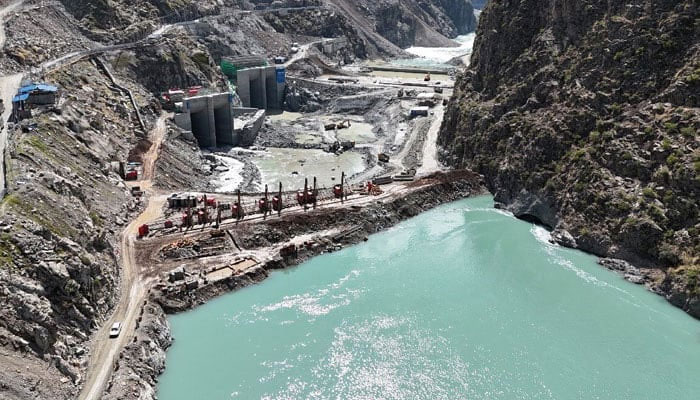
ISLAMABAD: The National Assembly was informed on Friday that the federal government is financing the construction of 32 dams during the current fiscal year.
Minister for Water Resources Musadik Malik told the house during question hour that once completed, these projects will have the capacity to store about 8,429,288 acre-feet of water.
“The new areas that will come under irrigation after the completion of these dams will be 436,934 acres,” he said.
Malik said that each province is receiving its share of water. He said that a contract has been awarded for the installation of an automatic telemetry system to help resolve water-related disputes among the provinces.
“These projects are aimed at storing surplus water available during the flood season and providing it for irrigation and drinking purposes when the natural flow of water in rivers decreases,” he explained.
During the current fiscal year, the federal government is sponsoring the construction of 32 dam projects at a cost of Rs1,056.985.586 million.
“Once completed, these projects will store about 8,429,288 acre-feet of water,” the National Assembly was informed.
He said that the new areas to be irrigated after the completion of these 32 dams will span 436,934 acres. Additionally, the 6.4 million acre-feet of water stored in the Diamer Basha Dam will be used to enhance irrigation supplies to the existing 45 million acres of canal-irrigated land in the Indus Basin Irrigation System.
In light of water scarcity and climate change concerns, several projects are in the planning stages, including the Shyok Dam Multipurpose Project (5.0 MAF), Akhori Dam Project (6.0 MAF), Chiniot Dam Project (0.9 MAF), and Murunj Dam Project (0.45 MAF).
At the outset, he clarified that water, including groundwater, is a devolved subject. In this context, the provinces are responsible for legislation and implementation regarding the monitoring and regulation of groundwater.
It was further noted that the National Water Policy 2018, approved by the provinces, aims to address the emerging water crisis and provide a policy framework for sustainable water resource management.
Malik stressed that Pakistan’s federal system grants provinces significant autonomy under the 18th Amendment. “The National Water Policy provides a national framework within which provinces can develop their master plans for sustainable development and water resource management,” he said.
He said that while water resources are a national responsibility, sectors such as irrigation, agriculture, water supply, and the environment are provincial subjects. The 2018 National Water Policy sets comprehensive guidelines, recognising groundwater as a critical resource for the country.
The policy also stipulates the establishment of regulatory bodies for groundwater management.
“It is paramount to establish regulatory bodies for groundwater, with a mechanism ensuring sustainability, transparency, efficiency, safety, and affordability. For this purpose, a ‘Groundwater Authority’ will be established in each province,” Malik said.
Regarding monitoring groundwater potential and preparing groundwater budgets for sub-basins and canal commands, the 2018 National Water Policy urges provincial governments to enforce legislation and take regulatory measures.
In a separate response to a question about Russia’s offer of assistance for Pakistan Steel Mills (PSM), Minister for Industries and Production Rana Tanveer Hussain told the National Assembly that, to date, Pakistan has not entered into formal communication with Russia regarding the restoration of PSM.
However, he said that during a meeting with the president on April 4, 2024, the Russian ambassador had offered assistance for PSM’s restoration.
“Pakistan has also considered establishing a new steel mill,” he stated in a written reply.
The written reply highlighted that in 2003, an MoU was signed between Pakistan and Russia for the revival and expansion of PSM, which led to an agreement with Tyazhpromexport Russia. Another MoU was signed in 2013, in which Pakistan had sought a US$ 1 billion credit facility from Russia.
In response to another question regarding health coverage for Islamabad, the Ministry for National Health Services, Regulations, and Coordination informed the National Assembly that Universal Health Coverage (UHC) for Islamabad had begun on January 1, 2022, covering all permanent resident families of Islamabad until December 15, 2023.







-
 Jonathan Majors Set To Make Explosive Comeback To Acting After 2023 Conviction
 -
 Next James Bond: Why Jacob Elordi May Never Get 007 Role?
 -
 Maddox Drops Pitt From Surname In Credits Of Angelina Jolie’s New Film 'Couture' Despite Truce From Father's End In Legal Battle
 -
 Burger King Launches AI Chatbot To Track Employee Politeness
 -
 Andrew’s Woes Amid King Charles’ Cancer Battle Triggers Harry Into Action For ‘stiff Upper Lip’ Type Dad
 -
 Experts Warn Andrew’s Legal Troubles In UK Could Be Far From Over
 -
 Teyana Taylor Reflects On Dreams Turning Into Reality Amid Major Score
 -
 Jennifer Garner Drops Parenting Truth Bomb On Teens With Kylie Kelce: 'They're Amazing'
 -
 AI Is Creating More Security Problems Than It Solves, Report Warns
 -
 'Game Of Thrones' Prequel 'A Knight Of The Seven Kingdoms' New Ratings Mark Huge Milestone
 -
 Apple Seeks To Dismiss Fraud Suit Over Siri AI, Epic Injunction
 -
 Delroy Lindo Explains The Crucial Role Of Musical Arts In Setting Up His Career Trajectory
 -
 Timothée Chalamet Reveals How He Manages To Choose The Best Roles For Himself
 -
 Princesses Beatrice, Eugenie’s Conflict Gets Exposed As Mom Fergie Takes Over The Media
 -
 Kate Middleton Plays Rock-paper-scissors In The Rain
 -
 Lindsay Lohan On 'confusing' Teen Fame After 'Mean Girls': 'I Should Have Listened To My Mom And Dad'