
‘Indo-Pacific strategy is to contain China’
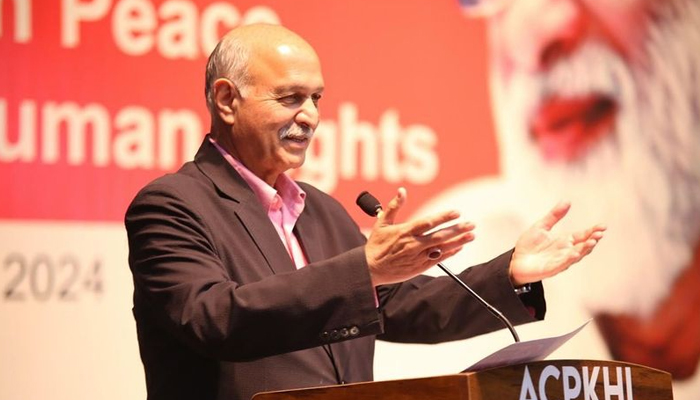
Islamabad:Former Senator Mushahid Hussain Sayed has said that Pakistan is against a regional situation similar to witnessed during Cold War years and disagrees with joining camps to counter any country, especially against its trusted friend China.
Mr Mushahid was addressing at an event on “US’ Asia-Pacific strategy: implications for Pakistan-India relations” organised by Institute of Regional Studies (IRS) here Friday.
Zameer Akram, Adviser, Strategic Plan Division, pointed out that under the so-called Indo- Pacific strategy, many analysts believed that US intended to act as a full-spectrum dominant power with evident control of sea lanes to counter China’s rise. For this objective, the US had even expanded the scope of NATO from Europe to Middle East and Asia, so to contain China. He also highlighted that the US backing emboldened India which was emerging as an aggressor in the region.
Prof Zafar Jaspal stated that India and the US already have a threshold alliance. In view of the aggressive policies of Prime Minister Modi, capacity building of India by the US as a non-NATO ally posed a serious challenge for Pakistan. However, while India was ostensibly working for American interests and receiving assistance accordingly, its regional challenges were multiplying because of its aggressiveness which was exposing its limitations and duplicity.
Former Ashraf Jehangir Qazi stressed that the change of nomenclature Asia-Pacific to Indo-Pacific for a containment strategy by US placed India in a central role fancying targeting China. But China, unlike the former Soviet Union, could not be challenged and defeated by no means through empowering India. He stressed that to avoid a dangerous global conflict, Pakistan must stay clear of any part in such hostile endeavours. He also emphasised that China had never projected itself as a Super Power but only as emerging global power.
Security expert Syed Muhammad Ali noted that China did not seek regional and global hegemon status, rather was economically countering US influence in regions all over the world by building mutually beneficial partnerships. He also noted that within the region, India’s act of aggression was witnessed in case of Pulwama, Galwan and Occupied Kashmir.






-
 Benny Blanco Addresses ‘dirty Feet’ Backlash After Podcast Moment Sparks Online Frenzy
 -
 Sarah Ferguson Unusual Trait That Confused Royal Expert
 -
 Prince William, Kate Middleton Left Sarah Ferguson Feeling 'worthless'
 -
 Ben Affleck Focused On 'real Prize,' Stability After Jennifer Garner Speaks About Co Parenting Mechanics
 -
 Luke Grimes Reveals Hilarious Reason His Baby Can't Stop Laughing At Him
 -
 Why Kate Middleton, Prince William Opt For ‘show Stopping Style’
 -
 Here's Why Leonardo DiCaprio Will Not Attend This Year's 'Actors Award' Despite Major Nomination
 -
 Ethan Hawke Reflects On Hollywood Success As Fifth Oscar Nomination Arrives
 -
 Tom Cruise Feeling Down In The Dumps Post A Series Of Failed Romances: Report
 -
 'The Pitt' Producer Reveals Why He Was Nervous For The New Ep Of Season Two
 -
 Maggie Gyllenhaal Gets Honest About Being Jealous Of Jake Gyllenhaal
 -
 'Bridgerton' Star Luke Thompson Gets Honest About Season Five
 -
 Prince William On Verge Of Breakdown Because Of 'disgraced' Andrew
 -
 Tig Notaro Reflects On Oscar Nod For 'Come See Me In The Good Light': 'I Was Sleeping'
 -
 Kenyon Sadiq Sets 40-yard Dash Record At NFL Scouting Combine, Eyes First Round
 -
 Talk Show Host Drops Hint About Taylor Swift, Travis Kelce Wedding Date