
Climate change: a common threat, a hope of unity
Congratulations to the entire nation on the anniversary of one of the most significant events of the last century: the creation of Pakistan. However, the political struggles before 1947 and the efforts to strengthen Pakistan afterward could be undermined by the long-ignored and dire threat of climate change.
On July 22, 2024, the highest average global temperature in history was recorded. For the past few years, Lahore has consistently ranked as the most polluted city in the world. Abnormal rainfall patterns have turned rainstorms from a blessing into a burden, leading to annual floods that cause population displacement, unemployment, and health issues.
Heatwaves in major cities, including economic and political hubs like Karachi, Lahore, and Islamabad, are causing social shutdowns and health crises. This summer, Karachi, in particular, has experienced abnormally high and unbearable temperatures. Pakistan’s forest cover has dwindled to about 5% from approximately 33% in 1947, which can be seen as a complete collapse rather than just a decline.
Only now, as people endure the extreme heat, have they begun to take climate change seriously. If further ignored, our civilisation risks repeating the fate of the Indus Valley civilisation, which transformed from a vibrant society into a symbol of devastation and destruction primarily due to climate change thousands of years ago.
This ancient civilisation thrived between 5000 and 3000 years ago along the banks of the Indus River in present-day Pakistan. Renowned for its planning, infrastructure, and city management, it was a peace-loving and prosperous society with agriculture as its backbone. The abundance of crops made it well-developed and affluent. However, climate change was the primary reason for its decline.
The Indus Valley people used countless bricks to construct their cities, cutting down trees for fuel in their brick manufacturing, leading to deforestation and shifts in climatic patterns. Evidence shows at least six major floods during the civilisation’s decline, caused by rainstorms similar to those we see today. The disappearance of the ancient Saraswati River, likely due to climate changes, led to the displacement of settlements and the loss of assets.
The history of the Indus Valley Civilisation’s decline is eerily similar to the present situation in Pakistan. Just as they indulged in construction projects, we are witnessing numerous mega housing societies today. We, too, have cleared acres of land to build these societies, resulting in deforestation.
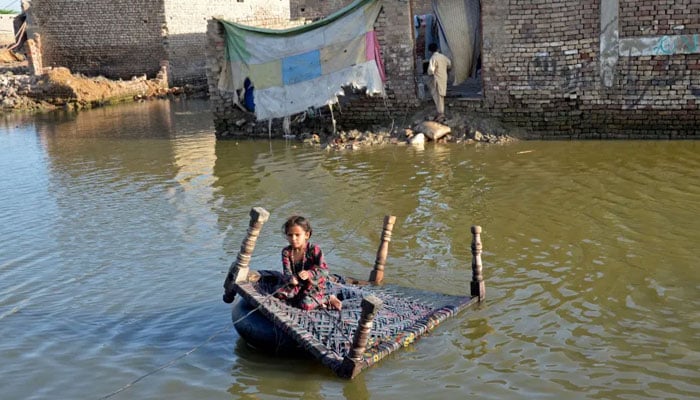
Frequent floods plagued the Indus Valley, and we also experience annual flooding. As in ancient times, rainstorms now cause these floods by delivering heavy rain in a single day. Like the Indus Valley people who migrated to interior India, flood-affected Pakistanis are displaced from their native places.
The Indus Valley civilisation perished due to staggering climate changes. If a climate emergency is not declared in Pakistan now, our existence might soon become a chapter in the history.
Climate change is a common threat that has the power to unite a nation. In 2014, it forced economic rivals like the U.S. and China to come together to commit to reducing carbon emissions. As the largest carbon emitters, they bear significant responsibility, but the same applies to other countries, including Pakistan.
Bhutan serves as an example for the world. Despite being small, it is the only nation that is carbon-negative, meaning it removes more carbon from the environment than it emits. Bhutan’s approach to sustainable development offers a model for Pakistan to follow.
Pakistan’s PTI government launched the Billion Tree Tsunami project to combat deforestation and climate change. They also banned plastic bags to reduce pollution. Recent initiatives include the Ten Billion Tree Tsunami Programme, the Clean Green Pakistan Movement, and the National Electric Vehicle Policy to lower transportation sector emissions. These efforts are part of a broader strategy to enhance environmental sustainability and resilience against climate impacts.
Disintegration, differences, opposition, resistance, hopelessness, and complaints have characterised the past 77 years of our history. Today, however, a common threat-climate change-presents an opportunity for all of us to unite. The impact of climate change is uniformly devastating across all social classes: the rich and the poor, the educated and the uneducated, Hindus, Muslims, Christians, civil and military leadership, the opposition and the ruling party, men, women, and transgender individuals alike. While it is unfortunate that an external threat must be the catalyst for internal unity, this pressing danger could serve as a crucial opportunity to bring together not just Pakistan, but the entire world, if we do not ignore it any longer.







-
 Shamed Andrew Wants ‘grand Coffin’ Despite Tainting Nation
 -
 Keke Palmer Reveals How Motherhood Prepared Her For 'The Burbs' Role
 -
 King Charles Charms Crowds During Lancashire Tour
 -
 ‘Disgraced’ Andrew Still Has Power To Shake King Charles’ Reign: Expert
 -
 Why Prince William Ground Breaking Saudi Tour Is Important
 -
 AOC Blasts Jake Paul Over Bad Bunny Slight: 'He Makes You Look Small'
 -
 At Least 53 Dead After Migrant Boat Capsizes Off Libya
 -
 'God Of War' Announces Casting Major Key Role In Prime Video Show
 -
 Real Reason Prince William, Kate Broke Silence On Andrew Scandal Revealed
 -
 Drew Barrymore Responds To 'Charlie's Angels' Costar's Comments About Her
 -
 Shakira Slips Hard On Stage During Life Show
 -
 King Charles Speaks Out Over Andrew's Scandal: 'Stand Ready To Help Police'
 -
 Dax Shepard Recalls Horrifying Accident That Almost Killed Him
 -
 Logan Paul's Bodyguard Hits Fan On Super Bowl Day
 -
 Epstein Files: Anne Hathaway Mentioned As Highly Desired Guest For Bill Gates?
 -
 Prince Harry Under A Lot Of Stress As Meghan Markle Makes Bizarre Demands