
Urdu Bazaar traders concerned over textbooks shortage
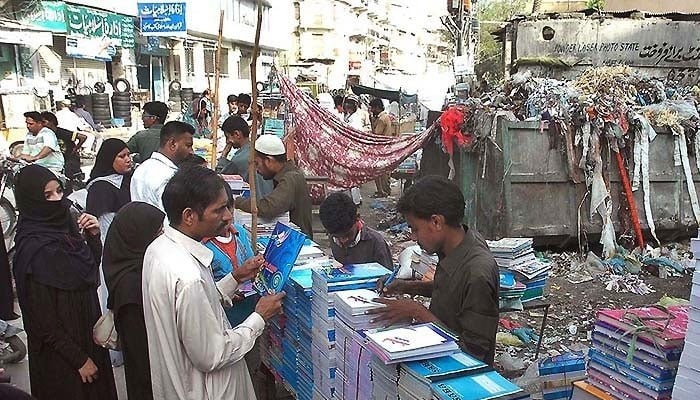
Amid an already delayed academic session, the Urdu Bazaar Traders Association has highlighted concerns about a significant scarcity of textbooks on the market.
Speaking at a press conference on Monday, association executives Sajid Yousuf, Hussain Abbas, Ali Muhammad Awan, Nadeem Akhter and Farhan Kaghzi stated that 30 to 40 percent of essential syllabus books are still missing, causing problems for both students and parents.
Key textbooks missing include the Class 10 Math book, the Class 5 Urdu book, the Chemistry and Physics books for classes 9 through 12, and the Class 10 English book. Even more concerning is the fact that computer books for classes 9 and 10 have been out of supply for the previous six months, while Biology books for classes 11 and 12 are also unavailable.
Hussain Abbas, the general secretary of the Urdu Bazaar Traders, cited a recent 18-20 percent tax rise on stationery after the current fiscal year’s budget as an additional strain on parents. Basic school supplies like pencils, watercolors, erasers, and inkpots have seen price increases, prompting Abbas to call for the formation of a committee to address the increased financial burden on families. Sajid Yousuf, Sindh Traders Association chairman, was critical of the Sindh Textbook Board. He accused board officials and publishers of ineptitude and avarice, claiming that the academic year began in August rather than April, affecting nearly 1.5 million students in public and private institutions across the province.
Yousuf warned that if similar delays persist, the Inter test failures from last year, caused by late textbook supplies, could recur this year. He attributed this year’s troubles to continuing legal challenges involving a single publisher.
Farhan Kaghzi exacerbated the situation by highlighting the frustration of parents who search the Urdu Bazaar for entire textbook sets, only to come home empty-handed. He called for the academic year to resume in April and encouraged quick action to begin printing books for the following year. Kaghzi also proposed limiting any single publisher’s contract to a maximum of 20,000 books to avoid future monopolies and delays.
The textbook deficit is quickly becoming a severe issue, threatening to disrupt the education of thousands of students if immediate action is not taken. The Urdu Bazaar Traders Association has urged prompt action before the issue gets out of control.







-
 What You Need To Know About Ischemic Stroke
 -
 Shocking Reason Behind Type 2 Diabetes Revealed By Scientists
 -
 SpaceX Cleared For NASA Crew-12 Launch After Falcon 9 Review
 -
 Meghan Markle Gives Old Hollywood Vibes In New Photos At Glitzy Event
 -
 Simple 'finger Test' Unveils Lung Cancer Diagnosis
 -
 Groundbreaking Treatment For Sepsis Emerges In New Study
 -
 Roblox Blocked In Egypt Sparks Debate Over Child Safety And Digital Access
 -
 Savannah Guthrie Addresses Ransom Demands Made By Her Mother Nancy's Kidnappers
 -
 OpenAI Reportedly Working On AI-powered Earbuds As First Hardware Product
 -
 Andrew, Sarah Ferguson Refuse King Charles Request: 'Raising Eyebrows Inside Palace'
 -
 Adam Sandler Reveals How Tom Cruise Introduced Him To Paul Thomas Anderson
 -
 Washington Post CEO William Lewis Resigns After Sweeping Layoffs
 -
 North Korea To Hold 9th Workers’ Party Congress In Late February
 -
 All You Need To Know Guide To Rosacea
 -
 Princess Diana's Brother 'handed Over' Althorp House To Marion And Her Family
 -
 Trump Mobile T1 Phone Resurfaces With New Specs, Higher Price