
‘Disturbing strategic stability equation will not be allowed’
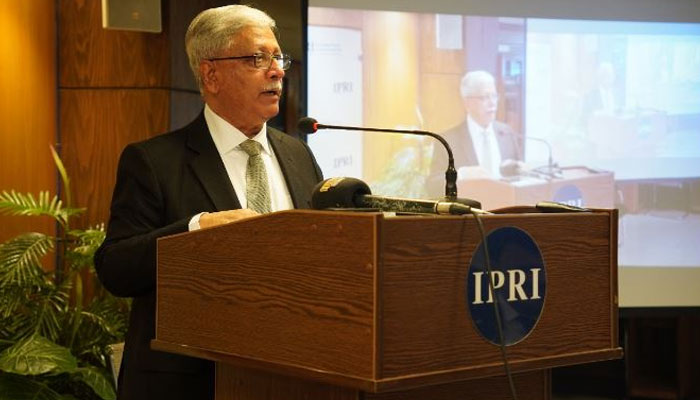
Islamabad:Lieutenant General (r) Khalid Ahmed Kidwai, advisor, to National Command Authority and former DG, Strategic Plan Division, has said that it has increasingly become Pakistan’s responsibility not to allow the strategic stability equation to be disturbed to its disadvantage.
General (r) Kidwai was commenting on the dynamic and elusive nature of changing geo-political realities in the region at a talk organised here by the Institute of Regional Studies (IRS).
General (r) Kidwai called Pakistan’s strategic weapons, especially the tactical nuclear weapons, as ‘weapons of peace’ as they had been effectively ensuring strategic equilibrium in the region. He also noted that Pakistan’s nuclear programme enjoys a wide national consensus as being central to Pakistan’s national security and was indeed an inherent strength. He said that Pakistan's entire spectrum of deterrence—from strategic to operational and tactical, combined with its ready nuclear capability—demonstrates Pakistan's resolve to protect its land from any kind of external aggression.
He emphasised that ‘Pakistan’s Full Spectrum Deterrence (FSD) doctrine is effectively countering India’s aggressive designs and keeping its ‘Cold Start Doctrine’ or ‘Proactive Operations’ under check. He criticised India’s mantra of ‘Ghar mein ghus ke marenge’ (will chase infiltrators inside Pakistan) as mere political rhetoric stemming from frustration over Pakistan's strong nuclear capabilities that deterred one of the world’s largest militaries.
General (r) Kidwai told the participants that Pakistan has always shown restraint and maturity as a responsible nuclear power in defusing Indian-generated tensions and preventing them from spiralling into potential catastrophe as was evident from the Balakot incident in 2019.
He underscored that Pakistan’s strong nuclear capability had constrained India’s conventional military options, leading India to engage in 5th generation warfare against Pakistan. He emphasised the need for increased vigilance and preparedness. He noted that the retaliatory options of “offensive-defence” were valid for countering that hybrid strategy since ‘defensive-defence’ alone could not do so.
Dr Zafar Nawaz Jaspal, Dean of Social Sciences, QAU, said that Pakistan must adopt a multi-pronged strategy to counter India’s propaganda machine. He also noted that the growing US defence collaboration with New Delhi to counter China was further complicating South Asia's already fragile security environment, highlighting the necessity for nuclear diplomacy.
Earlier, Jauhar Saleem, president, IRS, cautioned that India's increasing defence procurement and advanced weaponry posed new threats to South Asia’s stability beyond the threat of direct confrontation. He also highlighted the desirability of resumption of dialogue and revival of confidence-building measures amid region's increasingly fragile strategic environment.







-
 Leonardo DiCaprio's Co-star Reflects On His Viral Moment At Golden Globes
 -
 SpaceX Pivots From Mars Plans To Prioritize 2027 Moon Landing
 -
 J. Cole Brings Back Old-school CD Sales For 'The Fall-Off' Release
 -
 King Charles Still Cares About Meghan Markle
 -
 GTA 6 Built By Hand, Street By Street, Rockstar Confirms Ahead Of Launch
 -
 Funeral Home Owner Sentenced To 40 Years For Selling Corpses, Faking Ashes
 -
 Why Is Thor Portrayed Differently In Marvel Movies?
 -
 Dutch Seismologist Hints At 'surprise’ Quake In Coming Days
 -
 Australia’s Liberal-National Coalition Reunites After Brief Split Over Hate Laws
 -
 DC Director Gives Hopeful Message As Questions Raised Over 'Blue Beetle's Future
 -
 King Charles New Plans For Andrew In Norfolk Exposed
 -
 What You Need To Know About Ischemic Stroke
 -
 Shocking Reason Behind Type 2 Diabetes Revealed By Scientists
 -
 SpaceX Cleared For NASA Crew-12 Launch After Falcon 9 Review
 -
 Meghan Markle Gives Old Hollywood Vibes In New Photos At Glitzy Event
 -
 Simple 'finger Test' Unveils Lung Cancer Diagnosis