
Tales of dishonour
Honour crimes also target men. In Sikandar Ali Lashari vs The State, SHC upheld conviction passed by ATC for honour killing of son of a district judge
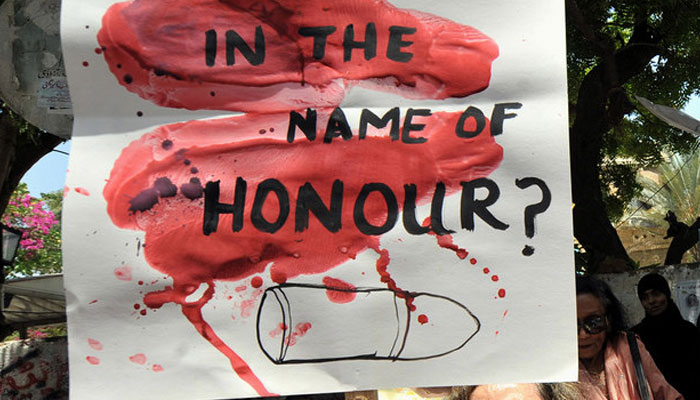
Last month, a viral video on social media showing a man strangling his sister – now identified as 22-year-old Maria Bibi – in the presence of his father enraged a majority of people.
While there have been cases where political or religious sentiments have been used to justify violence against women, ordinary Pakistanis commit honour crimes to uphold their traditions. In 2008, a senator from Balochistan defended an incident of three teenage girls and two women in the province being buried alive for wishing to marry of their own will, arguing that it was part of tribal customs.
However, in 2005, the Bugti tribe revolted against authorities for dishonouring them by refusing to prosecute the rape of 31-year-old Dr Shazia Khalid at a Sui gas plant. The company involved advised the victim’s brother to register only the robbery case and abandon the rape charges. She was later declared ‘kari’ (stained or impure) by a jirga in Khairpur, Sindh.
In 2021, the daughter of a Pakistani diplomat, Noor Mukadam, was tortured, raped and beheaded in Islamabad.
The Aurat March, an annual event where women-led rallies are organized in various Pakistani cities on International Women’s Day (March 8) to raise awareness about women’s rights and GBV, is criticized for imposing Western values and raising vulgar slogans which may offend Pakistani parents. This is hypocrisy, since in most cases family members are responsible for committing honour crimes.
In April 1999, 29-year-old Samia Sarwar from Peshawar, who wanted to end her abusive marriage and remarry, was killed by an assassin accompanied by her mother in her lawyer Hina Jilani’s office. The for-hire murderer was hired by her mother for dishonouring the family.
Similarly, Rukhsana Naz, a British-Pakistani, was forcefully married to her cousin at the age of 15 and killed by her mother and brother in 1988, when she was 19 because she wanted to marry someone else. The Nottingham Crown Court pronounced the mother and the brother guilty, highlighting the UK’s forced marriages issue. Similarly, in 2003, British-Pakistani Shafilea Iftikhar Ahmed (17) was murdered by her parents for refusing to forcibly marry.
In 2023, a father shot her daughter, aged 19, in a district courts in Karachi for marrying of her free will. In 2016, Qandeel Baloch, aged 26, was strangled by her brother for dishonouring her family and tribe through her online videos. The Lahore High Court (LHC) allowed her parents to forgive her brother, discarding the Criminal Law (Amendment) (Offences in the Name or Pretext of Honour) Act, 2016, which declares honour killing as ‘fasad-fil-arz’ (causing disorder on land) and makes it non-compoundable under Section 311 of the Pakistan Penal Code, 1860.
Honour crimes also target men. In Sikandar Ali Lashari vs The State, the Sindh High Court upheld the conviction passed by the Anti-Terrorism Court (ATC) for the honour killing of the son of a district judge. In that case, another district judge had hired an assassin to get the judge’s son killed. Rule 8 of the Sindh Civil Servants (Efficiency and Discipline) Rules, 1973, should apply to the convicted District & Sessions Judge, which provides for his dismissal from service by the competent authority upon conviction on moral turpitude charges.
Islam protects women from false accusations of adultery. However, in 1983, under the 1979 Hudood laws Safia Bibi, a visually impaired girl, was convicted for not producing four male Muslim witnesses who abstain from major sins. However, her rapist was set free. Later, since the case had no evidence, the Federal Shariat Court acquitted her.
Mukhtaran Bibi was gangraped as a form of ‘honour revenge’ in Muzaffargarh, Punjab, sanctioned by panchayat (village jury). The Supreme Court of Pakistan acquitted the accused while wrongly concluding that an unmarried virgin woman’s testimony has precedence over a divorced non-virgin woman’s testimony, even though virginity is not required for testimony under the 1979 Hudood laws and the Qanun-e-Shahadat Ordinance, 1984.
Curbing honour crimes seems a daunting task especially when traditions and customs continue to blind individuals and institutions.
The writer is a lawyer and a faculty member at the Department of International Relations, University of Karachi.







-
 Social Media Addiction ‘like Smoking’: Mumsnet Calls For Under-16s Ban With Cigarette-style Warnings
 -
 Andrew Mountbatten, Virginia Giuffre's Photos Attached To Buckingham Palace Gates
 -
 Everything We Know About Bruce Willis Frontotemporal Dementia
 -
 Singapore's Grab Plans AI-driven Expansion And New Services To Boost Profit By 2028
 -
 Adele Reveals How She 'snapped Out Of' Sever Postpartum Depression
 -
 ‘Chinamaxxing’ Explained: Inside Viral Gen Z Trend Taking Over TikTok And Instagram
 -
 Fears Erupt About Sarah Ferguson Pulling A ‘Harry’ While Sitting On A King’s Ransom: ‘Her Leverage Still Stands’
 -
 Lisa Rinna Slams Andy Cohen For His Below The Belt Move: 'So Shady'
 -
 Stunning New Photos Of The Milky Way Shed Light On How Stars Are Formed
 -
 Prince Harry, Meghan Face Fresh Calls To Lose Royal Titles Over ‘pseudo-royal’ Visit
 -
 Gordon Ramsay On His Basal Cell Carcinoma Diagnosis
 -
 Fukushima Decommissioning: Japan Deploys Snake-like Robot To Remove Nuclear Debris
 -
 Brenda Song Turns Macaulay Culkin's 'Home Alone' Into 'terrible' Lesson: 'Children Have To Be A Little Scared'
 -
 MrBeast Vows To Book Only Starlink-equipped Flights As Global Airline Adoption Surges
 -
 Kim Jong Un Says North Korea Ready To ‘get Along’ With US But Sets Key Condition
 -
 Andrew Fears What Comes Next As Jeffrey Epstein Scandal Deepens