
How a messaging bot is helping PTI supporters
Post says: “Another innovative way to find PTI nominated candidate for your constituency, along with allotted electoral symbol!
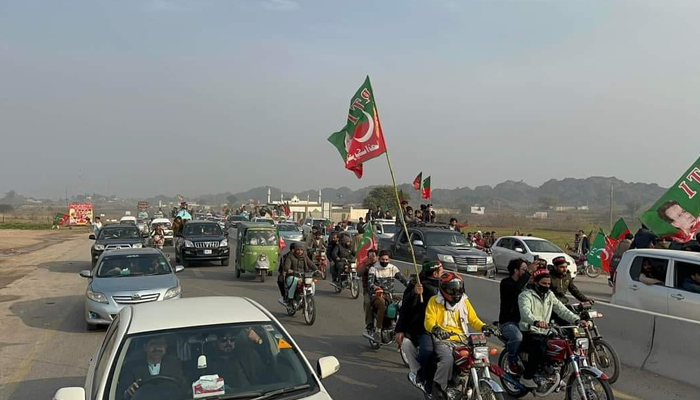
KARACHI: Just two weeks before the February 8 elections, the Pakistan Tehreek-e-Insaf (PTI) has launched a messaging bot to inform its voters about the symbols allotted to its now-independent candidates.
On January 24, the PTI’s official account on X (formerly Twitter) announced that voters can find out about the symbols allotted to the PTI-affiliated candidates by sending a direct message to Imran Khan’s official Facebook page. [At the time of filing of the story, the post had 346,500 views].
The post says: “Another innovative way to find PTI nominated candidate for your constituency, along with the allotted electoral symbol! Just send a message to Imran Khan’s official FB page with your constituency number and you will receive the information within a few minutes.”
The party has used Facebook’s ‘Automated responses’ feature to allow voters to find out the electoral symbols of candidates contesting from their constituencies.
While the post on X says that the information will be available within a few ‘minutes’, the messaging bot is faster than that. The reply comes within a few seconds (five seconds when The News tested it). The reply comes in two messages: the first one gives the details of the contesting person and the electoral symbol, and the second provides a link to the public WhatsApp channel created for information related to that constituency. It also includes short clips of Imran Khan’s message from jail to his supporters/voters.
Ever since the PTI lost its ‘bat’ symbol, the party has been coming up with novel strategies to inform people about the symbols allotted to its candidates who are now contesting as independents. The party has also launched insaf.pk/election2024 and a backup web page ‘pticandidates.com’ to allow people to find the symbol allotted to PTI-affiliated candidates.
The page requires visitors to enter the constituency number and instantly displays the name of the candidate and their symbol. At the end of the page is a link to join the ‘halqa’s’ (constituency) WhatsApp channel.
The PTI’s official website ‘insaf.pk’, however, is inaccessible. In a post published on X on January 24, Bytes For All confirmed this: “Local probing by @OpenObservatory confirms that http://insaf.pk (the official website of PTI, a political party in Pakistan) is currently not opening in the country. However, it is accessible via VPNs.”
The PTI is also being supported by worker-led initiatives online. For example, an anonymous X user and party worker has independently launched an offline Android-compatible application, ‘Insaf Ka Nishan’, that provides information about the PTI’s candidates. The app’s updated version was launched on January 23, 2024, and so far, it has been downloaded 1,589 times.
While the PTI is using the available tools to spread its message and move on from its setbacks, other political parties have not embraced the social media age effectively and are relying mostly on showing their street power.
In his comments to The News on the performance of political parties on the digital front, digital rights advocate and founder of Media Matters for Democracy (MMfD) Asad Baig says, “It is difficult to analyze [which political party] is performing better because there is no documentation or mapping of [the parties’ digital campaigns].”
Baig elaborates: “In 2018, the PTI used a constituency management system (CMS), which was basically an app with a database of voters. This time as well, I think, they have created a similar CMS and are using it. I believe that this use of technology can improve parties’ [election] campaigns.”
But he thinks there are several limitations. For instance, “parties are unable to make the most of technology due to the lack of digital literacy within the political parties. The trend of using technology is a little slow in political groups here. I think social media is mainly used by political parties (all of them) to weaponize their narratives and launch attacks on each other.”
He further adds that “the use of social media or digital platforms [for election campaigns] among political parties is rare.”







-
 King Charles, Princess Anne, Prince Edward Still Shield Andrew From Police
 -
 US Set To Block Chinese Software From Smart And Connected Cars
 -
 Carmen Electra Says THIS Taught Her Romance
 -
 Leonardo DiCaprio's Co-star Reflects On His Viral Moment At Golden Globes
 -
 SpaceX Pivots From Mars Plans To Prioritize 2027 Moon Landing
 -
 King Charles Still Cares About Meghan Markle
 -
 J. Cole Brings Back Old-school CD Sales For 'The Fall-Off' Release
 -
 GTA 6 Built By Hand, Street By Street, Rockstar Confirms Ahead Of Launch
 -
 Funeral Home Owner Sentenced To 40 Years For Selling Corpses, Faking Ashes
 -
 Why Is Thor Portrayed Differently In Marvel Movies?
 -
 Dutch Seismologist Hints At 'surprise’ Quake In Coming Days
 -
 Australia’s Liberal-National Coalition Reunites After Brief Split Over Hate Laws
 -
 DC Director Gives Hopeful Message As Questions Raised Over 'Blue Beetle's Future
 -
 King Charles New Plans For Andrew In Norfolk Exposed
 -
 What You Need To Know About Ischemic Stroke
 -
 Shocking Reason Behind Type 2 Diabetes Revealed By Scientists