
Nothing to report on
Journalism is often called the fourth pillar of democracy. But over the years, especially with the rise of autocratic governments, efforts have been made to make this important pillar toothless. Censorship, threats, and attempts made to block advertising revenue for media outlets have badly hit press freedom in Pakistan.
Now, a ban has apparently been imposed on media coverage of certain court cases, particularly the cipher case which involves former prime minister Imran Khan and PTI leader Shah Mehmood Qureshi.
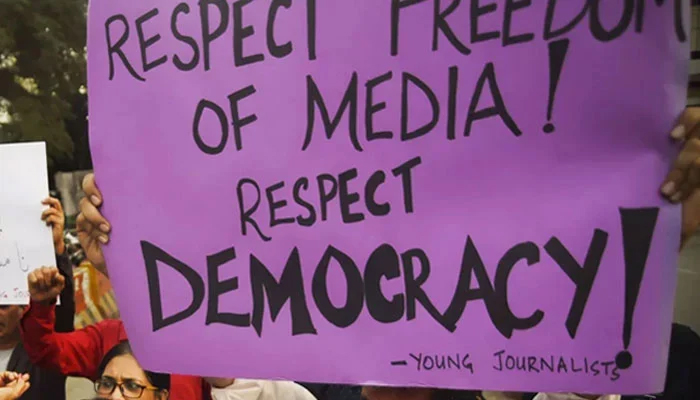
Three media organizations – the Pakistan Federal Union of Journalists (PFUJ), the Council of Pakistan Newspaper Editors (CPNE), and the Association of Electronic Media Editors and News Directors (AEMEND) – have strongly objected against the new form of censorship and said that “the restraint was surprising”. It merits a mention that a couple of months ago, Chief Justice Qazi Faez Isa headed the first-ever live streaming of a Supreme Court hearing. That exercise was appreciated by both law professionals and ordinary people who shared that such initiatives would make more people interested in the country’s political process. In a country where, according to a 2014 survey by Gallup, only 47.7 per cent people follow current events “somewhat”, such a blanket ban will lead to a nation unaware of the complexities faced by the country. From party supporters to critics, people have the right to know the merits of any such case and what transpires during the proceedings.
Those responsible for such bans should realize that lack of information will do no good. Instead, it allows conspiracy theorists and other propagandists to exaggerate the situation, spreading more paranoia among the people. And while a censorship exercise is never good, it should be vehemently opposed at a time when we are less than two months from an important election. The ever-changing red lines in mainstream media have already made it difficult for journalists to report on what’s happening in the country. The situation becomes even more difficult when those who are supposed to provide some relief to the country also choose suppression over liberty.
We saw one example of knee-jerk suppression of information last week, when some sites on the internet were shut down in what seemed to be an attempt to discourage internet users from participating in a ‘virtual’ jalsa. And now banning the coverage of a case that involves a popular leader will also prove to be futile. Pakistan has already witnessed awful consequences of short-term strategies employed to remove one person from power. We cannot see a repeat of the 2016-2018 period when the dismantling of the political process was in full swing. There is no room for repeating the same mistakes, and the time now is to fix the fractured democracy in the country, not hurt it further.







-
 Jennifer Hudson Gets Candid About Kelly Clarkson Calling It Day From Her Show
 -
 Shamed Andrew Was With Jeffrey Epstein Night Of Virginia Giuffre Assault
 -
 Shamed Andrew’s Finances Predicted As King ‘will Not Leave Him Alone’
 -
 Bad Bunny Faces Major Rumour About Personal Life Ahead Of Super Bowl Performance
 -
 Sarah Ferguson’s Links To Jeffrey Epstein Get More Entangled As Expert Talks Of A Testimony Call
 -
 France Opens Probe Against Former Minister Lang After Epstein File Dump
 -
 Last Part Of Lil Jon Statement On Son's Death Melts Hearts, Police Suggest Mental Health Issues
 -
 Leonardo DiCaprio's Girlfriend Vittoria Ceretti Given 'greatest Honor Of Her Life'
 -
 Beatrice, Eugenie’s Reaction Comes Out After Epstein Files Expose Their Personal Lives Even More
 -
 Will Smith Couldn't Make This Dog Part Of His Family: Here's Why
 -
 Kylie Jenner In Full Nesting Mode With Timothee Chalamet: ‘Pregnancy No Surprise Now’
 -
 Laura Dern Reflects On Being Rejected Due To Something She Can't Help
 -
 HBO Axed Naomi Watts's 'Game Of Thrones' Sequel For This Reason
 -
 King Charles' Sandringham Estate Gets 'public Safety Message' After Andrew Move
 -
 Lewis Capaldi Sends Taylor Swift Sweet Message After 'Opalite' Video Role
 -
 Brooklyn Beckham Plunges Victoria, David Beckham Into Marital Woes: ‘They’re Exhausted As It Seeps Into Marriage