
IHC suspends 40pc ‘windfall tax’ on banks
Islamabad High Court (IHC) has suspended the imposition of 40 percent Windfall Tax on banks till the next date of hearing
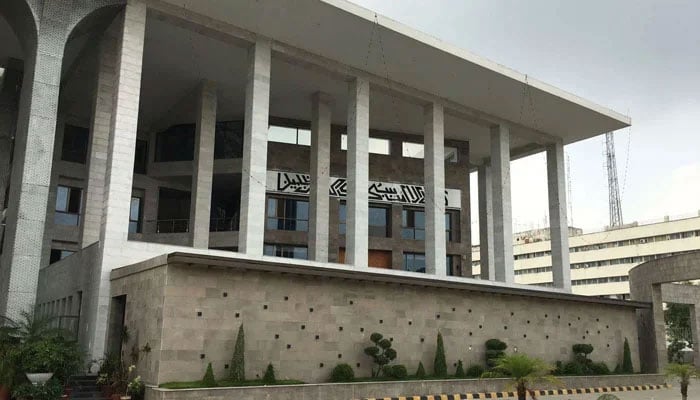
ISLAMABAD: The Islamabad High Court (IHC) has suspended the imposition of 40 percent Windfall Tax on banks till the next date of hearing.
The FBR, which has been assigned to collect Rs768 billion for achieving the outgoing monthly (November) target, was expecting to collect Rs35 to Rs40 billion through the Windfall Tax on lofty profits earned by the banks but now this tax was suspended for the time being.
Askari Bank and one of its shareholders filed a petition through Salman Akram Raja and Asad Ladha, advocates. In the order sheet, the honourable judge of IHC stated that the petitioner bank and one of its shareholders are aggrieved of the impugned SRO 1588(1)/2023, dated 21.11.2023, issued under Section 99D of the Income Tax Ordinance 2001 by which the banking companies have been subjected to “additional tax” at 40% on their windfall income that is to be computed in accordance with the formula given in the impugned SRO.
The learned counsel contends that Section 99D is tantamount to excessive delegation of power by the parliament by leaving into the federal government to determine any rate of tax between 0% and 40%, which is in breach of Article 77 of the Constitution of the Islamic Republic of Pakistan. He contends that the impugned SRO has been issued by the caretaker government, which per settled law can only attend to day-to-day affairs and cannot extend its authority to a fresh taxation measure.
He goes on to state that the SRO is also defective in that the determination of the preconditions under Section 99D, namely, the economic factors that led to the windfall income as well as the quantum of the windfall income, are conspicuous by their absence in the impugned SRO, and by a reading of the SRO there is only an underlying but unvalidated assumption that economic factors have actually operated and led to a windfall income but without these being spelt out in the notification, which would be expected given the letter and spirit of Section 99D. He referred to the formula under the SRO, which takes the arithmetic mean for the past 6 years as the key referent by year period to be taken into account for the purposes of additional tax under Section 99D.
Another argument is that the charge of additional as conflicts with entry no. 47 in the Legislative List for imposing an additional tax which is not warranted in terms thereof.
In view of the submissions made above and given that the tax is due in terms of the SRO by 30th of November, a case for interim relief is made out.
Another submission by the learned counsel to be recorded in the context of this application for interim relief is that, in terms of Section 99D(3), the notification levying the additional tax on windfall income is to be laid before the National Assembly, which not only assumes that a National Assembly is in existence (for it is to be laid ‘within’ 90 days) but, more to the point, it is quite possible that the National Assembly would not agree and may refuse to bless the notification issued under Section 99D, in which case the additional tax would no longer be valid and, in case of its earlier recovery, it would be the petitioners who would be out of pocket for the interim period for which the federal government is unlikely to pay any interest and, therefore, the loss of use of the taxpayer’s funds for that period without any compensation does appear to meet the test of irreparable loss.
The Section 99D, being a charging section, appears inchoate in that it does not spell out the consequences of the National Assembly disagreeing with the government’s computation of the windfall income or its chosen rate of additional tax, and the benefit of the ambiguity over the precarious existence of the progeny of a charging section can only extend to the taxpayer.
Therefore, the SRO cannot but be taken to remain in abeyance until it is blessed by the National Assembly (assuming all other legal grounds operating in the department’s favour thereafter).
Learned counsel for the FBR submitted with reference to citations that legislation is to remain operative until it is declared ultra vires.
However, as rightly pointed out by the learned counsel for the petitioner, the interim relief sought is in respect of the impugned SRO, which is an executive act and not legislation and, therefore, prima facie not covered by the judgments on the point referred to by the learned counsel for the FBR.
The foregoing submissions, therefore, demonstrate not only a prima facie case but also that the ingredients of balance of convenience and irreparable loss operate in favour of the petitioner. Resultantly, the operation of the impugned SRO shall remain suspended till the next date of hearing.







-
 Benny Blanco Addresses ‘dirty Feet’ Backlash After Podcast Moment Sparks Online Frenzy
 -
 Sarah Ferguson Unusual Trait That Confused Royal Expert
 -
 Prince William, Kate Middleton Left Sarah Ferguson Feeling 'worthless'
 -
 Ben Affleck Focused On 'real Prize,' Stability After Jennifer Garner Speaks About Co Parenting Mechanics
 -
 Luke Grimes Reveals Hilarious Reason His Baby Can't Stop Laughing At Him
 -
 Why Kate Middleton, Prince William Opt For ‘show Stopping Style’
 -
 Here's Why Leonardo DiCaprio Will Not Attend This Year's 'Actors Award' Despite Major Nomination
 -
 Ethan Hawke Reflects On Hollywood Success As Fifth Oscar Nomination Arrives
 -
 Tom Cruise Feeling Down In The Dumps Post A Series Of Failed Romances: Report
 -
 'The Pitt' Producer Reveals Why He Was Nervous For The New Ep Of Season Two
 -
 Maggie Gyllenhaal Gets Honest About Being Jealous Of Jake Gyllenhaal
 -
 'Bridgerton' Star Luke Thompson Gets Honest About Season Five
 -
 Prince William On Verge Of Breakdown Because Of 'disgraced' Andrew
 -
 Tig Notaro Reflects On Oscar Nod For 'Come See Me In The Good Light': 'I Was Sleeping'
 -
 Kenyon Sadiq Sets 40-yard Dash Record At NFL Scouting Combine, Eyes First Round
 -
 Talk Show Host Drops Hint About Taylor Swift, Travis Kelce Wedding Date