
Senate resolution
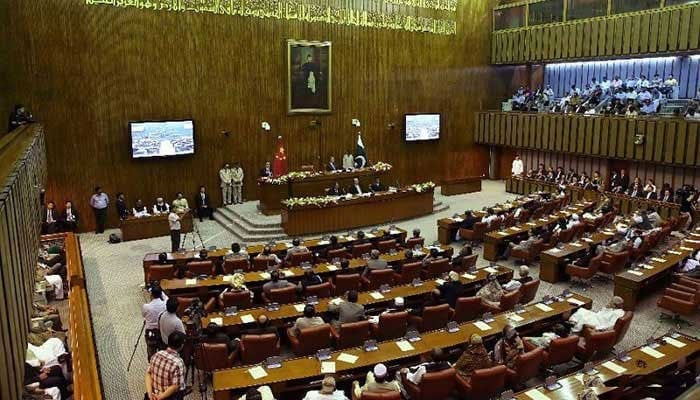
On Monday, the Senate of Pakistan – traditionally seen as the 'loftier' House, keeping a check on the moral ambiguities of governance – passed a resolution not just backing the military trials of civilians arrested in May 9 riots but also urging the Supreme Court to “reconsider” its verdict. The rationale offered by the Upper House? That the verdict was "an attempt" to "rewrite the law by impinging upon the legislative authority of parliament”; that the charge against the accused meant that such trials (in military courts) were an "appropriate and proportional response"; and that "the trial of individuals accused of anti-state vandalism and violence under the Army Act serves as a deterrent against such act". With some senators vocalizing their discomfort with the resolution, the Senate was adjourned till Tuesday. Needless to say, the Senate's resolution was seen by analysts as an alarming ceding of political space by political actors themselves. But it turns out that it is not just political observers who have pointed out the flaws in the Senate's demand and non-binding resolution. On Tuesday, PML-N Senator Saadia Abbasi spoke in the Senate and in unequivocal terms criticized the Monday resolution, terming it against the spirit of the constitution and of democracy and asking Senate members to condemn it. Abbasi also requested the withdrawal of the resolution, pointing to the lack of quorum when it was passed on Monday.
Last month, a five-member Supreme Court bench had in a landmark verdict said no to civilians accused in the May 9 riots being tried in military courts. The verdict was hailed by a full spectrum of legal experts, with very few in disagreement over it. Even before the Supreme Court verdict, many in the legal fraternity had pointed out that such trials would be against the constitution because even in the past following the APS attack, it had required a constitutional amendment to allow military courts and even that was criticized by human rights defenders and many legal experts. Senator Abbasi has pointed to much the same argument in her criticism of the Senate's resolution. Legal experts in the country have already said that military trials of civilians can be seen as a direct infringement of the basic and fundamental rights enshrined in the constitution of Pakistan as well as of Article 10A which gives every citizen the right to a fair trial.
Human rights and legal analysts have reasoned that when civilian courts are available then what is the need to try civilians in other courts? There are enough laws on our statutes to cover the trials of those accused of the May 9 riots. Why not trust our own system? We have previously also written that the country desperately needs a separation of powers tutorial for all its institutions. Perhaps we could start with the Upper House?






-
 Factory Explosion In North China Leaves Eight Dead
 -
 Blac Chyna Opens Up About Her Kids: ‘Disturb Their Inner Child'
 -
 Winter Olympics 2026: Milan Protestors Rally Against The Games As Environmentally, Economically ‘unsustainable’
 -
 How Long Is The Super Bowl? Average Game Time And Halftime Show Explained
 -
 Natasha Bure Makes Stunning Confession About Her Marriage To Bradley Steven Perry
 -
 ChatGPT Caricature Prompts Are Going Viral. Here’s List You Must Try
 -
 James Pearce Jr. Arrested In Florida After Alleged Domestic Dispute, Falcons Respond
 -
 Cavaliers Vs Kings: James Harden Shines Late In Cleveland Debut Win
 -
 2026 Winter Olympics Snowboarding: Su Yiming Wins Bronze And Completes Medal Set
 -
 Trump Hosts Honduran President Nasry Asfura At Mar-a-Lago To Discuss Trade, Security
 -
 Cuba-Canada Travel Advisory Raises Concerns As Visitor Numbers Decline
 -
 Anthropic Buys 'Super Bowl' Ads To Slam OpenAI’s ChatGPT Ad Strategy
 -
 Prevent Cancer With These Simple Lifestyle Changes
 -
 Air Canada Flight Diverted St John's With 368 Passengers After Onboard Incident
 -
 Experts Reveal Keto Diet As Key To Treating Depression
 -
 Inter Miami Vs Barcelona SC Recap As Messi Shines With Goal And Assist