
Comment: All merit, no-nepotism approach
Hard work and dedication are the only determining factors for success in the military, promoting a culture of fairness and equality
ISLAMABAD: Institutions that prioritize merit create a culture of excellence. Institutions that have a rigorous selection process based purely on merit are more effective and successful. Institutions, where individuals are evaluated based purely on their abilities, are able to achieve their goals and serve their stakeholders. Institutions that have a ‘no nepotism’ approach attract high-quality candidates and are able to retain top talent.
Five questions: Which Pakistani institution prioritizes merit? Which Pakistani institution has a rigorous selection process based purely on merit? Which Pakistani institution has a strict ‘no-nepotism’ approach? Can anyone name the Pakistani institution in which officers are promoted based on their performance? Which Pakistani institution has performance evaluations that are based on objective criteria, including the officer’s record of service and professional development?
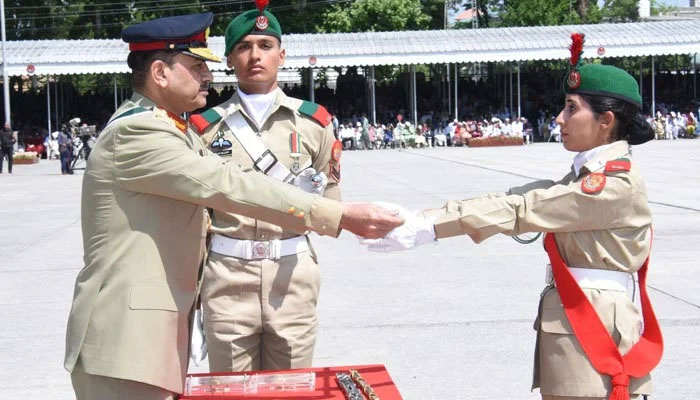
On April 29th, the Pakistan Military Academy held its passing-out parade for cadets, and it was a proud moment for the country. Senior Under Officer Abdullah Bin Tariq was awarded the Sword of Honour, a remarkable achievement considering his father’s profession as a teacher. The Gold Medalist, the son of a junior army officer, also made his family proud. This reflects the Pakistan Army’s unwavering commitment to a merit-based approach, free of any nepotism.
It is heartening to see that hard work and dedication are the only determining factors for success in the military, promoting a culture of fairness and equality. General Tikka Khan started his career as a soldier. General Yahya Khan, General Zia-ul-Haq, and General Pervez Musharraf came from modest backgrounds and did not have family connections to high-ranking military officers or politicians. They rose through the ranks based on their merits and achievements in the military. General Asif Nawaz rose through the ranks based on his military skills. General Raheel Sharif rose through the ranks based on his competence and leadership abilities.
General Ashfaq Parvez Kayani is the son of a junior commissioned officer (Subedar). His father, Chaudhary Muhammad Khan, served as a Non-Commissioned Officer (NCO) in the Pakistan Army. Despite being from a non-commissioned officer’s family, General Kayani rose through the ranks and became one of the most powerful military leaders in Pakistan’s history.
Yes, the Pakistan Army has a history of intervening in Pakistan’s politics. That should not be the case. Yes, the Pakistan Army can make itself more transparent and more accountable for its actions. Yes, the Pakistan Army is seen as a Punjabi-dominated institution; it can make itself more diverse. Yes, addressing these weaknesses can help strengthen the army and ensure its credibility and professionalism. To be certain, our civilian institutions can learn a lot from the Pakistan Army. Let us make all civilian institutions prioritize merit. Let all civilian institutions put in place a rigorous selection process based purely on merit. Let all civilian institutions implement a strict ‘no-nepotism’ approach. Let all civilian institutions promote officers purely on the basis of their performance-not based on their connections. By doing so our civilian institutions can also promote a culture of excellence. By doing so our civilian institutions can also achieve their goals and serve their real stakeholders.
The Pakistan Army places a strong emphasis on professionalism. Civilian institutions can learn from this. The Pakistan Army places a great emphasis on teamwork. Civilian institutions can adopt this approach by cultivating a culture of collaboration and teamwork. The Pakistan Army has a clear organizational structure. Civilian institutions can learn from this by ensuring that their structures are clearly defined, with well-defined roles and responsibilities. Within the Pakistan Army posting of officers is based on their qualifications and experience, and not based on any connections or recommendations.
Here are the four significant outcomes that can be expected when civilian institutions adopt an all-merit, no-nepotism approach: attract top talent, enhanced performance, improved morale and increased public trust. Plus, earn respect and admiration both at home and abroad.







-
 Leonardo DiCaprio's Co-star Reflects On His Viral Moment At Golden Globes
 -
 SpaceX Pivots From Mars Plans To Prioritize 2027 Moon Landing
 -
 J. Cole Brings Back Old-school CD Sales For 'The Fall-Off' Release
 -
 King Charles Still Cares About Meghan Markle
 -
 GTA 6 Built By Hand, Street By Street, Rockstar Confirms Ahead Of Launch
 -
 Funeral Home Owner Sentenced To 40 Years For Selling Corpses, Faking Ashes
 -
 Why Is Thor Portrayed Differently In Marvel Movies?
 -
 Dutch Seismologist Hints At 'surprise’ Quake In Coming Days
 -
 Australia’s Liberal-National Coalition Reunites After Brief Split Over Hate Laws
 -
 DC Director Gives Hopeful Message As Questions Raised Over 'Blue Beetle's Future
 -
 King Charles New Plans For Andrew In Norfolk Exposed
 -
 What You Need To Know About Ischemic Stroke
 -
 Shocking Reason Behind Type 2 Diabetes Revealed By Scientists
 -
 SpaceX Cleared For NASA Crew-12 Launch After Falcon 9 Review
 -
 Meghan Markle Gives Old Hollywood Vibes In New Photos At Glitzy Event
 -
 Simple 'finger Test' Unveils Lung Cancer Diagnosis