
Malala Yousafzai asks leadership to say no to Taliban militancy
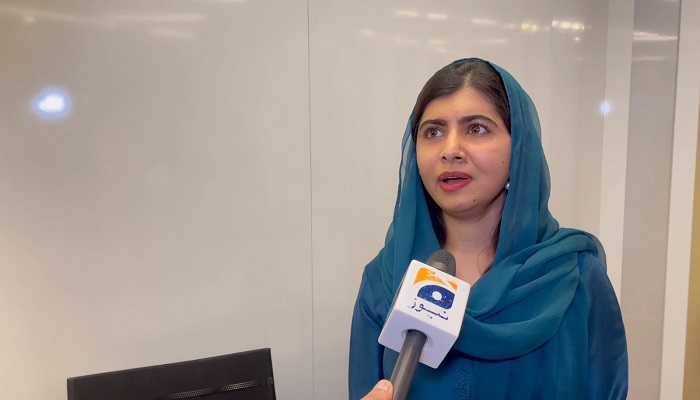
LONDON: Nobel Peace Prize winner Malala Yousafzai has called on political and religious leadership to say no to Taliban and no to all kinds of terrorism and militancy.
Malala was speaking to Geo and The News at the screening of Oscar-shortlisted documentary film Stranger at the Gate. Malala Yousafzai is executive producer of the film which deals with the subjects of conflict, Islamophobia, racism and power of forgiveness.
When asked about the rise of violent militancy in the region and especially in Pakistan, Malala called on the leadership to “come together for peace and say no to terrorism of all kinds and fight together against the extremist mindset using the name of Islam. She said: “Everyone has to come together against Taliban, challenge them and say that there is no justification for terrorist acts in Islam. Taliban should not be allowed to use the name of Islam, our values and traditions. We need peace and stability and security for the ordinary people.”
She said she onboarded Oscar-shortlisted documentary film Stranger at the Gate as the executive producer to bring communities together and to highlight the message of forgiveness and cohesion. The documentary tells the true story of Mac McKinney, a former US Marine who planned to attack a mosque and instead turned to Islam.
Malala said she decided to become executive producer of the film because the film challenges stereotypes and misconceptions about Muslims and Islam. “I decided to become executive producer of this film so that we could tell stories of those who are not heard enough. I wanted to project the issue of Islamophobia, stereotypes and Muslims in the west. This film has the power to create harmony and this becomes possible through connecting to people to know about their personal lives and stories. This film is a powerful true story of forgiveness and redemption,” she said.
Malala Yousafzai said she has learnt two powerful things from this film. “Our values have a wonderful impact. Forgiveness is very important as it changes lives. We should have a bigger heart for others. The Muslim wife in the film has a big heart. She has a big heart for the attacker. This tells us that we should not get into stereotyping others. We should connect with other people directly and broaden our perspectives based on our own first hand understanding. It’s very important that we keep challenging stereotypes.”






-
 Is Human Mission To Mars Possible In 10 Years? Jared Isaacman Breaks It Down
 -
 ‘Stranger Things’ Star Gaten Matarazzo Reveals How Cleidocranial Dysplasia Affected His Career
 -
 Google, OpenAI Employees Call For Military AI Restrictions As Anthropic Rejects Pentagon Offer
 -
 Peter Frampton Details 'life-changing- Battle With Inclusion Body Myositis
 -
 Waymo And Tesla Cars Rely On Remote Human Operators, Not Just AI
 -
 AI And Nuclear War: 95 Percent Of Simulated Scenarios End In Escalation, Study Finds
 -
 David Hockney’s First English Landscape Painting Heads To Sotheby’s Auction; First Sale In Nearly 30 Years
 -
 How Does Sia Manage 'invisible Pain' From Ehlers-Danlos Syndrome
 -
 Halsey Mentions How She 'gained Control' Over Endometriosis Condition
 -
 Teyana Taylor Says Choosing Movies Over Music 'dumb' Choice?
 -
 Poland Joins Spain In Move To Ban Social Media For Children Under 15
 -
 Shia LaBeouf Sent To Rehab For Not Taking ‘alcohol Addiction Seriously’
 -
 ‘Stingy’ Harry, Meghan Markle Crack Open A Chasm Despite Donation: ‘Do So At Your Own Peril’
 -
 Research Explores How TikTok’s Recommendation System May Influence Teen Beliefs
 -
 Google Wins Approval To Export South Korea’s High-precision Maps After 20 Years—With Strict Conditions
 -
 King Charles’ Health Battle: What Has Been Revealed About His Cancer So Far