
Pakistan asks IMF to send review mission to Islamabad
The government has finalised the macroeconomic and fiscal framework for the pending IMF review
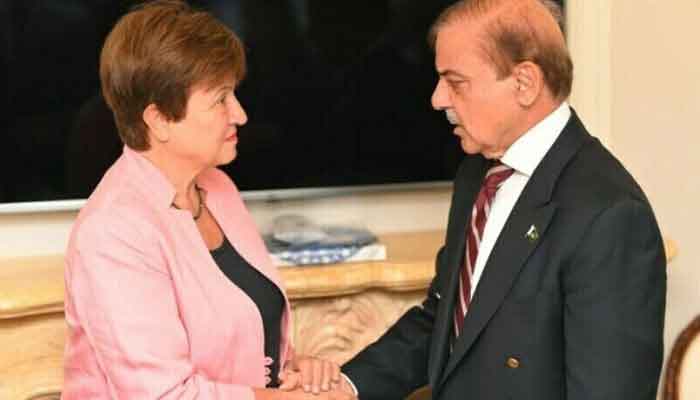
ISLAMABAD: After getting a nod from Prime Minister Shehbaz Sharif for implementing tough prescriptions of the lender as the last resort, Pakistan has sent a written request to the IMF for sending its review mission to Islamabad next week for breaking the deadlock and accomplishing the pending 9th Review under the $7 billion Extended Fund Facility (EFF).
Top official sources confirmed to a select group of reporters on Thursday night that Prime Minister Shehbaz Sharif chaired a consecutive second-day high-powered meeting of the economic team online from Lahore on Thursday evening and decided to invite the IMF review mission for visiting Islamabad next week for the conclusion of 9th Review and release of $1 billion tranche under the $7 billion EFF arrangement. “The government has concluded that there is no other choice but to revive the IMF programme on an immediate basis, so we have decided to invite the IMF. The secretary of finance has sent a written request to the IMF for sending its review mission and hopefully, the Fund will respond positively,” said the official sources, who added that the economic team under PM Shehbaz Sharif had finalised the macroeconomic and fiscal framework and attached conditions of the IMF. It would be implemented once agreed with the Fund mission on the negotiating table.
One top official said that there was an apprehension among the policymakers of Q Block (Ministry of Finance) that even if Islamabad implemented the IMF prescriptions by taking additional taxation measures, hiking power and gas prices, and allowing the exchange rate to depreciate, what would happen if the Fund staff labelled them insufficient actions. Therefore, the authorities decided to first evolve a consensus with the IMF on all the attached conditions and then implement them.
There is an understanding among the policymakers that Islamabad is left with no other options but to break the deadlock and revive the stalled IMF programme on a short-term basis to avert a full-fledged balance of payment crisis.
The government has finalised the macroeconomic and fiscal framework for the current fiscal year on the basis of which the pending 9th Review would be accomplished. In case both sides remained unable to finalise the 9th Review by the first week of next month, then the 9th and 10th Reviews might be clubbed. But at the moment, Pak authorities would make all last-ditch efforts to complete the pending 9th Review standalone. Then both sides could kick-start talks to accomplish the next review soon after approval of the next tranche from the IMF’s Executive Board.
Under the revised macroeconomic and fiscal framework, the government wants to convince the IMF on downward revision on Petroleum Development Levy target from Rs855 billion to Rs550 billion for the current fiscal year. The FBR’s tax collection target of Rs7,470 billion would remain intact. In December 2022, the FBR faced a shortfall of Rs225 billion but in accordance with the IMF’s agreed target, there was a shortfall of Rs82 billion in achieving the FBR target for the first half (July-Dec) period of the current fiscal year.
The mini-budget will be introduced through the promulgation of a Presidential Ordinance. According to the deadline after the agreement, the government wants to promulgate it with effect from February 1, 2023. It is because of the benefit of collecting additional taxes in the remaining period of five months (Feb-June) of 2023.
The FBR is also hopeful that the stay orders on important taxation from the courts will be cleared by March 2023, helping it achieve the desired tax collection target. However, according to an internal assessment done by the FBR, the tax machinery might face a shortfall of Rs170 billion owing to import compression, so the collection might be revised downward from Rs7,470 billion to Rs7,300 billion. The electricity and gas prices will be increased, especially the power tariff will be jacked up in a staggered manner. The IMF would also press hard for eliminating multiple exchange rates and allow the rupee to depreciate in line with the realistic fundamentals on the economic front.
In aftermath of the agreement, the rising inflation will be really challenging for the PDM-led regime. Secondly, they will have to face political fallout as a consequence of implementing the tough decisions prescribed by the IMF. But there is no other solution available to economic managers at a time when the risk of default hovers over the country.







-
 ‘Stingy’ Harry, Meghan Markle Crack Open A Chasm Despite Donation: ‘Do So At Your Own Peril’
 -
 Research Explores How TikTok’s Recommendation System May Influence Teen Beliefs
 -
 Google Wins Approval To Export South Korea’s High-precision Maps After 20 Years—With Strict Conditions
 -
 King Charles’ Health Battle: What Has Been Revealed About His Cancer So Far
 -
 Bad Bunny Tugs At People’s Heartstrings With A Generous Act Of Love: ‘Our Staff Didn't Even Realize’
 -
 Paramount Wins Warner Bros. Bidding War As Netflix Abandons Deal: Here’s Why
 -
 Cardi B Finally Responds To Accusations About Destroying 'SNL' Set After Nicki Minaj Joke
 -
 Gorton And Denton By-election Result: Green Party Defeats Labour In Blow To Keir Starmer
 -
 Jack Dorsey Cuts 4,000 Roles, Says AI Requires Smaller Teams
 -
 Reggie Bannister Health Takes ‘difficult Turn’ Amid Dementia, Parkinson’s Battle
 -
 'Humble Traitor' Rob Rausch Makes Unexpected Move After Betraying Maura Higgins In Season 4
 -
 Sarah Ferguson Drops An Accusation Against Andrew? ‘He Just Wants Leverage’
 -
 Anthropic Rejects Pentagon Military AI Proposal, Holds Firm On Safety Guardrails —What’s Next?
 -
 'Traitors' Reunion Drama: Rob Rausch Defends Strategy, Makes Shocking Revelation After Victory
 -
 Inside Hillary Clinton’s Epstein Testimony: Key Takeaways And Highlights Explained
 -
 'Too Hard To Be Without’: Woman Testifies Against Instagram And YouTube