
Xi broke promise on South China Sea: Top US general
Chairman of the Pentagon's Joint Chiefs of Staff, General Joseph Dunford, said he was not calling for military action against China, but stressed that there was a need to enforce international laws.
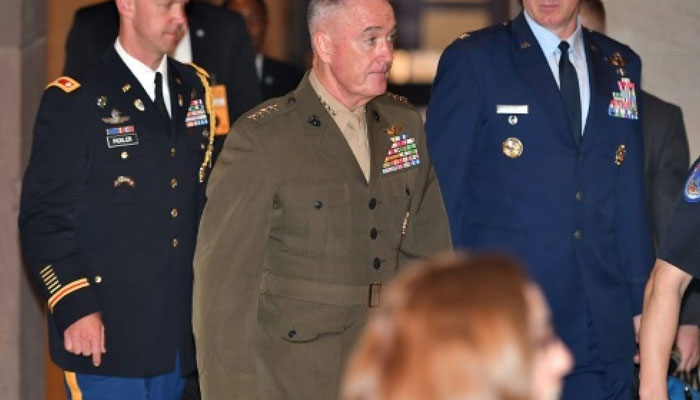
WASHINGTON: The US military's top general said Wednesday that Chinese President Xi Jingping reneged on promises not to militarize the South China Sea and called for "collective action" to hold Beijing responsible.
General Joseph Dunford, chairman of the Pentagon's Joint Chiefs of Staff, said he was not calling for military action, but stressed that there was a need to enforce international laws.
"The fall of 2016, President Xi Jinping promised President Obama that they would not militarize the islands. So what we see today are 10,000-foot runways, ammunition storage facilities, routine deployment of missile defense capabilities, aviation capabilities, and so forth," he said in a talk on US security and defense at the Brooking institution.
"So clearly they have walked away from that commitment."
"The South China Sea is in my judgement not a pile of rocks," he continued, referring to the series of reefs and outcrops that have been claimed as territory by China, reclaimed and expanded to accommodate military forces and large aircraft.
"What is at stake in the South China Sea and elsewhere where there are territorial claims is the rule of law, international laws, norms and standards."
"When we ignore actions that are not in compliance with international rules, norms and standards, we have just set a new standard."
"I'm not suggesting a military response," the top US general said.
"What needs to happen ... is coherent collective action to those who violate international norms and standards. They need to be held accountable in some way so that future violations are deterred."
Washington has been frustrated by an inability to stall China's aggressive military colonization of the South China Sea, which rejects conflicting territorial claims by five other countries: Vietnam, Malaysia, Brunei, Indonesia and Philippines.
The US has sent navy vessels through the areas claimed by China as "international freedom of navigation operations," but otherwise has found responding difficult.
Dunford acknowledged that building on the Chinese-claimed reefs had slowed.
However, he said, "I assume that's because the islands have now been developed to the point where they provide the military capability that the Chinese required them to have."




-
 Four people killed in stabbing rampage at Washington home
 -
 Jack Hughes's proximity to Trump angers Tate McRae fans
 -
 Nobel-winning scientist resigns from Columbia university after Epstein links revealed
 -
 At least 30 dead after heavy rains hit southeastern Brazil, 39 missing
 -
 Japan plans missile deployment near Taiwan by 2031 amid growing regional tensions
 -
 Trump delivers longest State of Union address in history: Inside key details on economy, security and global strategy
 -
 Trump’s 2026 State of Union address: Inside key takeaways, major policy shifts & top announcements
 -
 Rep. Al Green removed from House chamber during Trump’s State of Union address: Here’s what happened