
Both engines of Jeju Air contain duck DNA, says report
Report provides no initial conclusions about what may have caused plane to land without its landing gear deployed
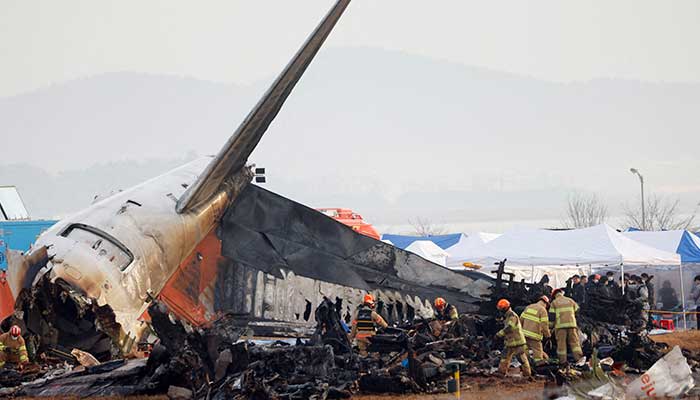
SEOUL: The Jeju Air plane's both engines contained duck remains, according to a preliminary report on Monday, with authorities still trying to determine what caused the deadliest air disaster on South Korean soil.
Released by South Korean authorities a month after the crash, the six-page report said both engines of the Boeing 737-800 jet contained DNA from Baikal Teals, a type of migratory duck that flies to South Korea for winter in huge flocks.
But the report provided no initial conclusions about what may have caused the plane to land without its landing gear deployed, and why flight data recorders stopped recording in the final four minutes of the flight.
The Jeju Air flight from Bangkok on December 29 overshot Muan Airport's runway as it made an emergency belly landing and crashed into an embankment containing navigation equipment, called localisers, killing all but two of the 181 people and crew members on board.
"After the crash into the embankment, fire and a partial explosion occurred. Both engines were buried in the embankment's soil mound, and the fore fuselage scattered up to 30-200 metres from the embankment," the report said, providing some new pictures of the accident site.
The localiser aids navigation of an aircraft making an approach to the runway, and the structure built of reinforced concrete and earth at Muan airport supporting the system's antennae likely contributed to the high death toll, experts have said.
The investigation will tear down the engines, examine components in depth, analyse in-flight and air traffic control data, and investigate the embankment, localisers and evidence of bird strike, the report said about its next steps.
"These all-out investigation activities aim to determine the accurate cause of the accident," it said.
Mayday
The report highlighted much of the initial findings by the South Korean investigators that were shared with victims' families on Saturday, including the pilots' awareness of a flock of birds on the plane's final approach.
The exact time the bird strike was reported by the pilots remains unconfirmed, the accident report said, but the aircraft "made an emergency declaration (Mayday x 3) for a bird strike during a go-around."
The report does not say what may have led to the Cockpit Voice Recorder (CVR) and Flight Data Recorder (FDR) to stop recording simultaneously just before the pilots declared the emergency.
The aircraft was at an altitude of 498 feet (152 metres) flying at 161 knots (298km/h or 185mph) about 1.1 nautical miles (2km or 1.3 miles) from the runway at the moment the flight recorders stopped recording, it said.
The International Civil Aviation Organisation (ICAO), a UN agency, requires accident investigators to produce a preliminary report within 30 days of the accident and encourages a final report to be made public within 12 months.
South Korea's Aviation and Railway Accident Investigation Board has shared its report with ICAO, Thailand, and the United States and France, which are the home states for the plane and engine manufacturers, an official said on Monday.





-
 China confirms visa-free travel for UK, Canada nationals
 -
 Bad Bunny's star power explodes tourism searches for his hometown
 -
 Murder suspect kills himself after woman found dead in Missouri
 -
 Poll reveals majority of Americans' views on Bad Bunny
 -
 Man convicted after DNA links him to 20-year-old rape case
 -
 California cop accused of using bogus 911 calls to reach ex-partner
 -
 'Elderly' nanny arrested by ICE outside employer's home, freed after judge's order
 -
 key details from Germany's multimillion-euro heist revealed