
What you need to know about effects of solar eclipse on your pets?
The April 8 total solar eclipse may trigger anxiety in your furry companions
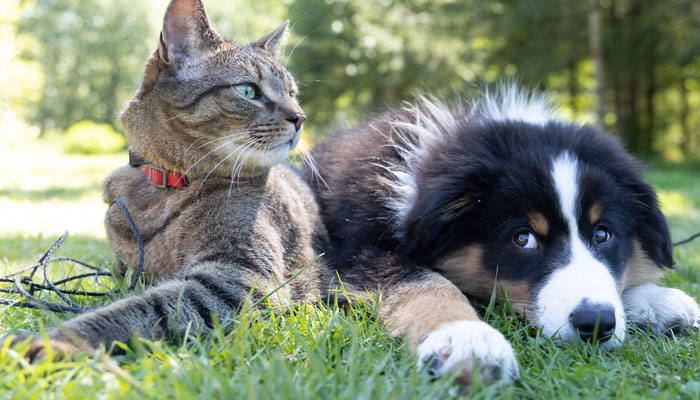
During a solar eclipse, the moon passes between the Earth and the sun, causing a sudden drop in light and temperature.
This can be confusing for animals, including our pets, as it disrupts their circadian rhythm - the internal biological clock that tells them when it's time to eat, sleep, or be active.
During the eclipse, which will last between 3.5 and 4 minutes, some pets may think it is nighttime and head to bed.
Dogs, being highly sensitive to changes in their environment, might exhibit signs of anxiety such as pacing, scratching, and howling. This is similar to how they might react to other unsettling events like thunderstorms or fireworks.
If you notice your dog showing these signs, it is important to remain calm and provide a comforting presence, as dogs often mirror their owners' emotions. You may try playing with them or offering a favourite toy to distract them.
Cats, on the other hand, are more likely to interpret sudden darkness as a signal that it is time to sleep. Indoor cats and some dogs might start showing the behaviours they usually exhibit before bedtime, such as yawning, stretching, or seeking out their favourite sleeping spot.
"The most likely response is animals starting their evening routines and showing evening behaviours," Erica Cartmill, a professor of anthropology, animal behaviour, and cognitive science at Indiana University told PEOPLE.
"If you have a dog or a cat, they might go to bed, get quieter, or start yawning and stretching."
Dr Bryan Pijanowski, a professor of forestry and natural resources at Purdue University, explains that most animals respond to the dimming light by preparing to rest or sleep. However, nocturnal animals might take it as a cue to wake up and start their nightly activities.
"Most animals respond to (the light dimming from the eclipse) in a way where it's like, 'OK, it's time to either sit down and rest and go to sleep," Dr Pijanowski said. "And then there are the nocturnal animals that suddenly say, 'Oh, it's time for me to wake up and be active."
NASA's Eclipse Soundscapes project aims to study animal behaviour during solar eclipses. During the April 8 total solar eclipse, participants will record data and submit their observations of animals in the wild.
Past studies have reported unusual behaviours in various animals during eclipses. For instance, whales and dolphins have been observed swimming to the water's surface, giraffes breaking into a run, and Galápagos tortoises beginning to mate. "They've done a lot of studies back in 2017 when we had an eclipse at some of the zoos in America, and some of the animals are affected by it," Steven Greene, the director of Lubbock Animal Services told KCBD News.
To ensure your pets' comfort during the solar eclipse, experts recommend keeping them indoors and maintaining a calm environment. Closing the blinds can help minimise the change in light, and providing a safe space where they can retreat if they feel anxious can also be beneficial.



-
 Archaeologists recreate 3,500-year-old Egyptian perfumes for modern museums
 -
 Smartphones in orbit? NASA’s Crew-12 and Artemis II missions to use latest mobile tech
 -
 Rare deep-sea discovery: ‘School bus-size’ phantom jellyfish spotted in Argentina
 -
 NASA eyes March moon mission launch following test run setbacks
 -
 February offers 8 must-see sky events including rare eclipse and planet parade
 -
 New study reveals biodegradable chip aims to reduce e-waste and air pollution
 -
 Scientists unveil new robotic mission for the moon
 -
 NASA reschedules Artemis II rehearsal due to Florida arctic outbreak