
Star Wars' aliens-like creatures discovered in Tanzanian jungle — New species
Professor Andy Marshall of USC reported that his team discovered millipedes, whose heads resembled characters from Star Wars
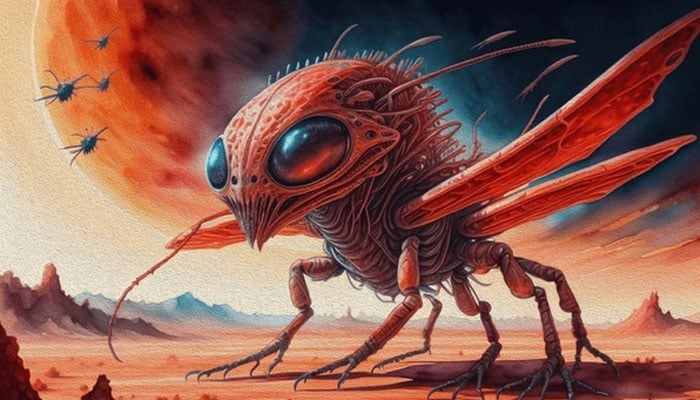
Five new species and a new genus of millipedes have been found by scientists in Tanzania's isolated jungles in southeast Africa.
According to the University of the Sunshine Coast in Australia, scientists found the millipedes in Tanzania's Udzungwa Mountains while investigating the growth of trees and vines.
Professor Andy Marshall of USC reported that his team discovered the millipedes, whose heads resembled characters from Star Wars, among the loose dirt and forest debris.
“We record millipedes of all sizes during our fieldwork to measure forest recovery because they are great indicators of forest health, but we didn’t realise the significance of these species until the myriapodologists had assessed our specimens,” Marshall said.
He mentioned that each of the recently found millipedes had roughly 200 legs and were only a few centimetres in length, according to the New York Post.
The largest millipedes seen in Africa had a maximum length of 35 centimetres or about 14 inches. The largest millipede species in North America is approximately half as long, measuring 15 centimetres, or 6 inches, according to the Missouri Department of Conservation.
The discovery of the new millipede genus and species, according to Marshall, shows how much more there is to learn about tropical forests.
The five new species are Attemsostreptus leptoptilos, Attemsostreptus julostriatus, Attemsostreptus magombera, Attemsostreptus leptoptilos, and Udzungwastreptus marianae, according to the USC. The new millipede genus is named Udzungwastreptus.
The University of Copenhagen at Denmark's Natural History Museum has received the millipede specimens.



-
 Total Lunar eclipse: What you need to know and where to watch
 -
 Sun appears spotless for first time in four years, scientists report
 -
 SpaceX launches another batch of satellites from Cape Canaveral during late-night mission on Saturday
 -
 NASA targets March 6 for launch of crewed mission around moon following successful rocket fueling test
 -
 Greenland ice sheet acts like ‘churning molten rock,’ scientists find
 -
 Space-based solar power could push the world beyond net zero: Here’s how
 -
 Hidden ‘dark galaxy' traced by ancient star clusters could rewrite the cosmic galaxy count
 -
 Astronauts face life threatening risk on Boeing Starliner, NASA says