
Supernovae: Why scientists are still perplexed about origin of star explosions?
Supernovae are celestial events that disperse radiation, light, elements, energy throughout space
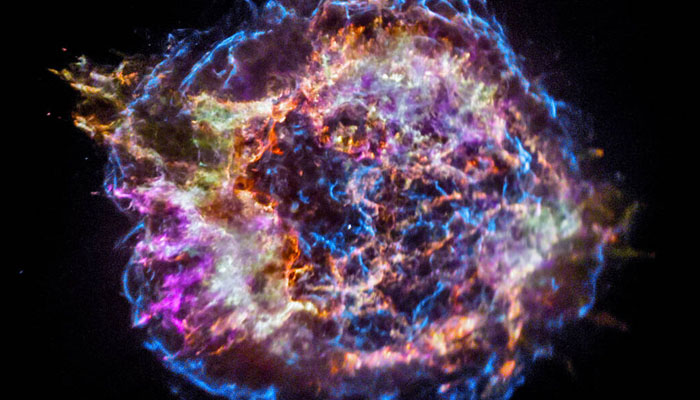
Supernovae are star explosions that shine brighter than a whole galaxy and have always captivated human attention but astrophysicists are still unable to account for the greater number of hydrogen-poor supernovae.
The identification of the missing progenitor star population has now been made possible in large part by a new Assistant Professor at the Institute of Science and Technology Austria (ISTA).
The findings, which have recently been published in Science, date back to a discussion the participating academics had as young scientists many years ago.
Certain stars don't just fade away; instead, they burst into a dazzling display of light that can dwarf entire galaxies. Supernovae are celestial events that disperse radiation, light, elements, and energy throughout space.
They can also produce new stars by compressing gas clouds through galactic shock waves. Stated differently, our cosmos is shaped by supernovae. Astrophysicists have long been perplexed by hydrogen-poor supernovae originating from big stars that explode.
The explanation is that scientists are unable to identify their progenitor stars. These supernovae seem to have materialised out of thin air.
“There are many more hydrogen-poor supernovae than our current models can explain. Either we can’t detect the stars that mature on this path, or we must revise all our models,” says ISTA Assistant Professor Ylva Götberg.
“Single stars would typically explode as hydrogen-rich supernovae. Being hydrogen-poor indicates that the precursor star must have lost its thick hydrogen-rich envelope. This happens naturally in a third of all massive stars through envelope stripping by a binary companion star,” says Götberg.


-
 Northern Lights: Calm conditions persist amid low space weather activity
 -
 SpaceX pivots from Mars plans to prioritize 2027 Moon landing
 -
 Dutch seismologist hints at 'surprise’ quake in coming days
 -
 SpaceX cleared for NASA Crew-12 launch after Falcon 9 review
 -
 Is dark matter real? New theory proposes it could be gravity behaving strangely
 -
 Shanghai Fusion ‘Artificial Sun’ achieves groundbreaking results with plasma control record
 -
 Polar vortex ‘exceptional’ disruption: Rare shift signals extreme February winter
 -
 Netherlands repatriates 3500-year-old Egyptian sculpture looted during Arab Spring