
Saturn's rings will become invisible to naked eye by 2025: Nasa
Next time Saturn-gazers will get to see its rings in October 2038, ahead of two events in the following year
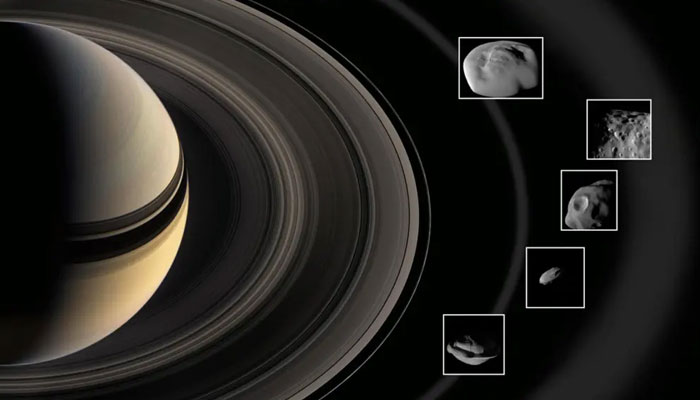
Saturn-gazers have only a little more than a year left to enjoy the gas planet's distinctive interstellar hula hoops as the US space agency, Nasa recently disclosed that they will disappear from view in 18 months, the New York Post reported on Monday.
The disappearance of the rings, fortunately, will only be due to an optical illusion, Nasa added.
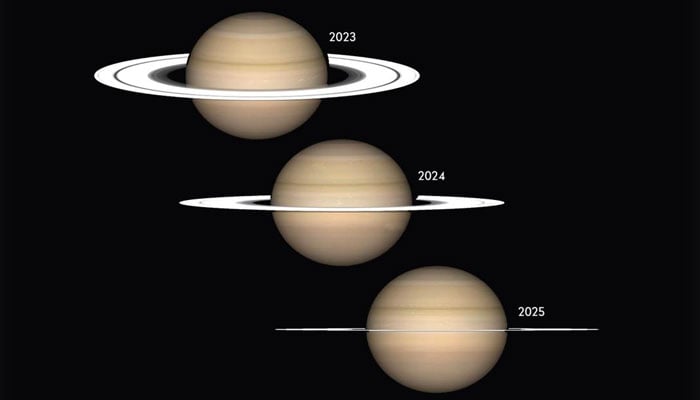
By March 2025, Saturn's famous rings — which span 43,500 to 87,000 miles, or the equivalent of 30 Earths — will no longer be visible from Earth because of the planet's tilt within its orbit.
The Earth sees Saturn on a horizontal plane every 13.5 to 15.7 years, causing cosmic dust bands to appear invisible. Despite their vastness, the rings are as thin as 300 feet in most places, despite being 746 million miles away.
The tilt of the adorned planet is currently 9 degrees downward and will drop to a barely noticeable 3.7 degrees by 2024.
According to Earth.com, seeing these celestial circles will resemble "a sheet of paper edge-on when it's positioned at the far end of a soccer field" when this angle reaches zero in March 2025.
Thankfully, we will not have to wait long for the ring’s return. The sixth rock from the Sun will rotate again, showcasing the other side of its hoops, with a peak display occurring in 2032 when the angle of tilt will hit 27 degrees.
The next time we will see Saturn from its side will be on October 15, 2038, with the next two events occurring on April 1 and July 9, 2039, forming an intergalactic hat trick.
Saturn has seven distinct rings, which are comprised of ice, rocky debris and dust, believed to be the remnants of comets, asteroids, and moons that were renamed by the planet’s powerful gravitational pull.
Unfortunately, these celestial bracelets could soon disappear for good and not just due to an orbital illusion.
Scientists claim that Saturn’s rings could vanish in as little as 300 million years — a blip on the cosmic time scale.




-
 Total Lunar eclipse: What you need to know and where to watch
 -
 Sun appears spotless for first time in four years, scientists report
 -
 SpaceX launches another batch of satellites from Cape Canaveral during late-night mission on Saturday
 -
 NASA targets March 6 for launch of crewed mission around moon following successful rocket fueling test
 -
 Greenland ice sheet acts like ‘churning molten rock,’ scientists find
 -
 Space-based solar power could push the world beyond net zero: Here’s how
 -
 Hidden ‘dark galaxy' traced by ancient star clusters could rewrite the cosmic galaxy count
 -
 Astronauts face life threatening risk on Boeing Starliner, NASA says