
VIDEO: Nasa's amazing black hole footage provides space tour
Video shows a number of black holes from small to massive ones
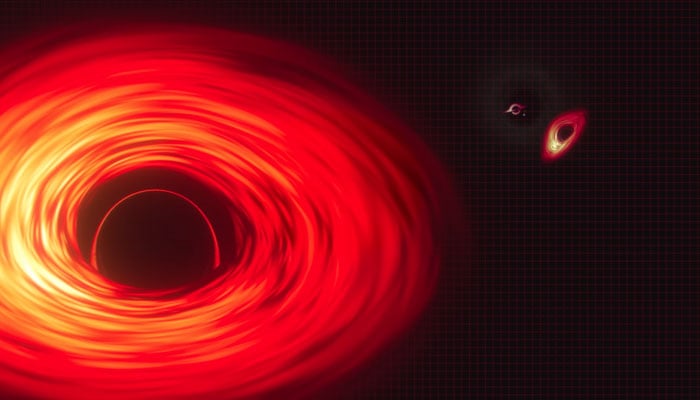
Black holes are massive space objects that arise when a star is dying, and they are also found usually at the centre of virtually every large galaxy.
If the earth were to crash into a black hole, it would be under an inch across. However, there are a number of black holes that are so massive that our solar system appears to be very tiny in front of them.
A video released by Nasa Monday shows a number of black holes from small to massive ones. It compares the size of black holes first with the sun and then all the way to a galaxy.
The gravitational pull of a black hole is so potent that no object can escape once it enters its event horizon. Not even light.
Nasa wrote: "This new NASA animation highlights the 'super' in supermassive black holes. These monsters lurk in the centres of most big galaxies, including our own Milky Way, and contain between 100,000 and tens of billions of times more mass than our Sun."
The animated video is over 90 seconds and offers you a tour of 10 black holes from tiny to supermassive ones.
When we encounter any conceptual image or picture of a black hole, it does not show an object with a dark spot but a luminous disk surrounding it comprising of gas and dust. The disk is called an "accretion disk".
The material revolving around the black hole is eventually eaten up and falls into a black hole. No one yet knows what is inside the black hole or what happens when an object falls into it.
Douglas Gobeille, an astrophysicist and black hole researcher at the University of Rhode Island, told Mashable that "black holes are terrible at eating things. They are notoriously picky eaters."
Astrophysicist Misty Bentz told Mashable that "we tend to anthropomorphise these things. But really, black holes aren’t evil, mean, or scary. They just… are."



-
 ‘Mars’ missing water mystery takes a surprising turn as new study finds regional dust storms trigger massive water loss into space
 -
 Scientists reveal how sleeping can unlock your creative potential
 -
 NASA Artemis 2 moon mission faces unexpected delay ahead of March launch
 -
 Total Lunar eclipse: What you need to know and where to watch
 -
 Sun appears spotless for first time in four years, scientists report
 -
 SpaceX launches another batch of satellites from Cape Canaveral during late-night mission on Saturday
 -
 NASA targets March 6 for launch of crewed mission around moon following successful rocket fueling test
 -
 Greenland ice sheet acts like ‘churning molten rock,’ scientists find