
Edible drones developed to deliver food during emergencies
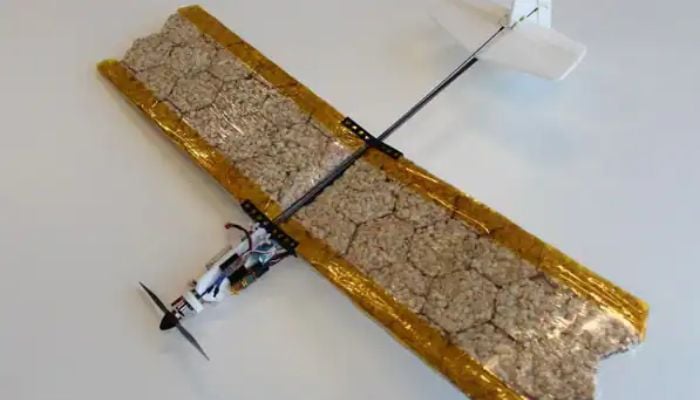
The wings of the plane are made of puffy rice cakes joined together with gelatin
Two decades ago, except for creative researchers, no one would have imagined that drones, aerial vehicles that can carry heavy loads that are often associated with bombing and their use in war, would be used in the healthcare sector and catastrophic situations.
Recently developed tiny food-delivering drones have the capacity to carry 10%-30% of their own weight but researchers at the Swiss Federal Institute of Technology, Lausanne (EPFL) decided to increase that ability to 50%.
The team of scientists developed edible wings as a result which means they did not have to engineer capacity into the machine. The partially edible aircraft is a part of "RoboFood", a project that is inventing edible robots for both humans and animals.
A paper "Towards edible drones for rescue missions: design and flight of nutritional wings" presented at the IEEE/RSJ International Conference on Intelligent Robots and Systems (IROS) conference in Kyoto discussed the details of the edible drone.
The small air vehicle is being made to be used during crisis situations like catastrophes. The drone can reach people in need of food. In cases of floods, for example, people are often stuck in challenging locations. While they wait for rescue teams and helicopters, there needs to be a way to provide food.
The wings of the plane are made of puffy rice cakes joined together with gelatin. Commercially, rice cakes are available in round shapes. Experts cut them into hexagon shapes so that they can stick together easily and be cut into wings. When the gelatin dries, wings are covered in plastic for hygiene as well as protection from humid environments.
The nutritious wingspan is 678 mm, delivering 300kcal through the rice cake and gelatin combined.


-
 Is human mission to Mars possible in 10 years? Jared Isaacman breaks it down
 -
 Total lunar eclipse to turn Moon red on March 2-3
 -
 Stunning new photos of the Milky Way shed light on how stars are formed
 -
 Antarctica’s mysterious ‘gravity hole’: What’s behind the evolution of Earth’s deep interior?
 -
 ‘Mars’ missing water mystery takes a surprising turn as new study finds regional dust storms trigger massive water loss into space
 -
 Scientists reveal how sleeping can unlock your creative potential
 -
 NASA Artemis 2 moon mission faces unexpected delay ahead of March launch
 -
 Total Lunar eclipse: What you need to know and where to watch